After Browns’ trade of Joe Flacco, how close is Shedeur Sanders to getting his chance?
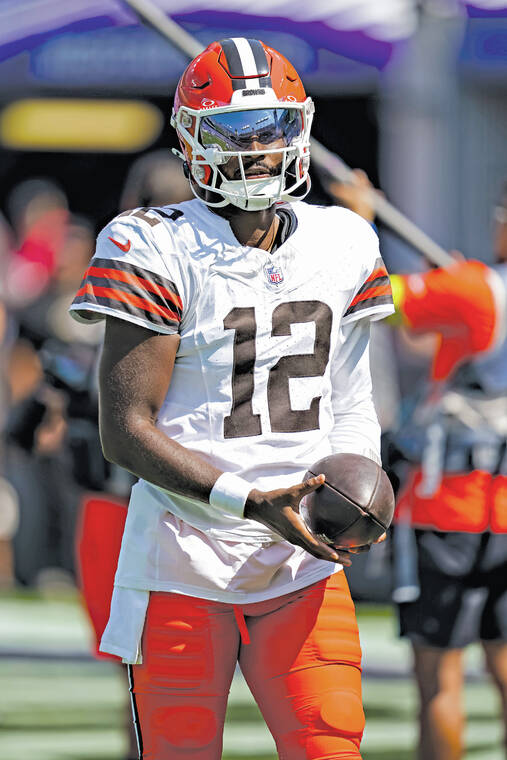
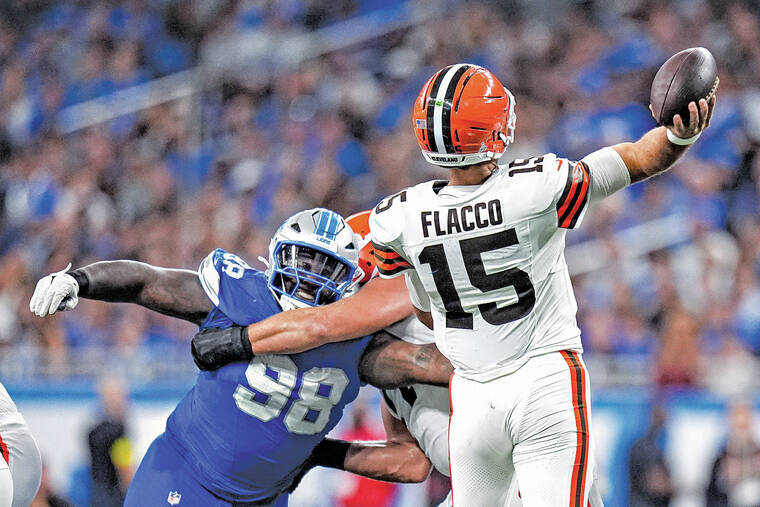
The Cleveland Browns dealt Joe Flacco to the Cincinnati Bengals on Tuesday, moving on from their Week 1 starter and completing their second trade of a veteran quarterback in the last six weeks.
Kenny Pickett, who took the first reps before missing most of training camp and all of the preseason with a hamstring injury, was traded to the Las Vegas Raiders on Aug. 25.
ADVERTISING
The youth movement that’s been on since the Browns drafted Dillon Gabriel and Shedeur Sanders in April was accelerated last week when they benched the 40-year-old Flacco and named Gabriel the starter. Right now, all that’s clear about the order in the quarterbacks room is that Gabriel is No. 1. The obvious internal hope is that he keeps the job for the rest of the season. Even at 1-4, the Browns aren’t totally sunk yet in the AFC North.
These Browns were probably always playing for the future — and that’s just one reason Cleveland coach Kevin Stefanski made the switch from Flacco to Gabriel. The offensive line woes and the early-season rash of dropped passes weren’t Flacco’s fault, but the Browns needed a spark after going three straight weeks of scoring just one touchdown.
Change had not only long felt inevitable, but in July, Browns owner Jimmy Haslam said the team needed to see both Gabriel, a third-round pick, and Sanders, a fifth-rounder, play this season before Cleveland finalized its plans for having its own first-round pick and Jacksonville’s next April.
The Browns’ decision-makers are relying on their rookie class to get them through an awkward transitional phase. The class as a whole is off to a strong start. Can Gabriel show improvement and create some explosive plays? Can Sanders get himself ready to play if circumstances dictate that he needs to?
Tuesday’s trade makes those questions even more pressing as the Browns head toward not only Sunday’s game at Pittsburgh (3-1), but to the rest of the season.
With Flacco gone, who might be up next as the season proceeds? Let’s explore.
Sanders
Sanders has been the emergency No. 3 quarterback for each of the team’s first five games, meaning he’s been dressed but only eligible to participate if both of the team’s other quarterbacks would have been injured.
Will his role as the most-discussed third quarterback in NFL history change, and will Stefanski make Sanders the primary backup? Does the Flacco trade signal that the Browns believe Sanders is ready to be a snap away from taking the reins?
We don’t know that as of now. That the Browns were willing to move on from Flacco and Pickett at the points they did indicates there’s at least a level of belief that Sanders can — and maybe will — play at some point this season.
Sanders played in two preseason games. He started the first and was mostly excellent after a choppy start. He threw two red zone touchdown passes and had no turnovers. After missing the following week’s game with an oblique injury, Sanders had a nightmarish outing in the preseason finale as he took five sacks and was benched instead of getting a two-minute drill, which loomed as a valuable opportunity for a rookie passer to grow and be further evaluated.
Since the start of the regular season, Sanders has played on the scout team and in post-practice opportunity periods. He’s shared the meeting room with Flacco, Gabriel, the injured Deshaun Watson and Bailey Zappe, who’s been on the practice squad and now could surpass Sanders as second in line. Stefanski has consistently refused to answer questions on how many scout team reps Sanders has received or how Cleveland gauges his progress, both on the practice field and in the meeting room.
Though Sanders showed off accuracy and arm talent throughout much of camp, he did not receive any reps with the No. 1 offense — even when Pickett and Gabriel missed time due to injury. As the draft order indicates, Gabriel arrived in May ahead of Sanders and has remained ahead at every checkpoint.
The Browns updated their standard weekly unofficial depth chart on Tuesday, with Gabriel as the starter and Sanders as the backup, but that provides no real clue on how the team will proceed.
First, it’s an unofficial depth chart that Stefanski has stated on the record is put together by the team’s public relations department. Secondly, Gabriel and Sanders are the only two quarterbacks on the active roster. The Browns’ updated weekly depth chart included the 52 players currently on the roster.
The team confirmed the Flacco trade Tuesday afternoon but announced no corresponding move.
Zappe
When the Browns signed Zappe back to the practice squad in late August after Kansas City released him on cutdown day, there was only one way to analyze his return: that Zappe, not Sanders, was the true emergency quarterback for the early part of the season in the wake of Cleveland trading Pickett and making Gabriel its primary backup.
Gabriel and Sanders had been participating in team activities since May, so why else would Cleveland go from having six quarterbacks on its 90-man summer roster to adding a veteran to its practice squad?
Six weeks into the season, it’s unclear if the Browns now view Sanders as being ahead of Zappe. For Zappe to be the No. 3 emergency quarterback Sunday, he’d have to be signed to the active roster. But he could serve as the No. 2 if he gets the standard game day promotion. For strategy reasons, it will be a surprise if Stefanski shares his true quarterback depth chart before Sunday morning.
Zappe started last season’s finale for the Browns and has made nine career starts. They didn’t bring him back in the offseason as they remade their quarterback room, and his NFL resume says he’s not a realistic starting option. We’ll soon find out if the Browns view him as their best backup plan this week, and in the weeks to come.
Watson
Watson is recovering from a second torn Achilles tendon, suffered in January while he was rehabbing from the injury he suffered last October. Watson started 19 games over three seasons in Cleveland after being acquired in a March 2022 trade with the Houston Texans that included six draft picks, three first-rounders. In the spring, Haslam called the trade “a big swing and a miss.”
If anything, that was an understatement. But Watson’s football future can best be described as murky, and that’s not completely discounting the possibility that he’ll play again for the Browns.
Cleveland placed Watson on the active-physically unable to perform list at the start of training camp, which kept the door open for a possible return at some point this season. At August’s roster cutdown, Watson was moved to the in-season PUP list, which meant he would be out at least four weeks and would not count against the 53-man roster. He did not return to practice in his first week eligible to, and Stefanski is not expected to open Watson’s practice window this week, either.
If Watson is eventually cleared and does return to practice, the Browns will then have 21 days before deciding to activate him or keep him shut down for the season.
Though it’s hard to believe that any Watson return this season was ever in the team’s plans, the active-PUP designation kept it possible — and this trade of Flacco theoretically moves Watson closer to actually playing. We stress theoretically, because even though Watson has been rehabbing and has been around the team since the spring, there’s no indication he’ll be medically cleared or that the Browns would play him even if he ends up getting activated.
Over the course of the spring and summer, all Stefanski and general manager Andrew Berry have said is that Watson has been attacking his rehab and that the focus of both the quarterback and the team has been solely on Watson getting healthy.
There is no deadline for a potential Watson activation. There used to be a return-to-play window for players on the PUP list (and other similar lists) that would expire in the back half of the season, but that no longer exists.
Watson’s contract, which runs through 2026, is fully guaranteed. His salary-cap number this season is $35.9 million, and his 2026 cap number is $80.7 million. The Browns will have to make a decision — or maybe the first in a series of decisions — on how to handle Watson’s contract in early 2026, with one potential option being a post-June 1 release and another being a further series of restructures if Watson remains on the roster.
As currently constructed, Watson’s deal is on the team’s salary cap through 2029.
Someone else?
There’s no way this quarterback carousel could spin outside the four mentioned above, right? Well, these are the Cleveland Browns. Of course there’s a way.
Gabriel is the 41st starting quarterback of the team’s post-1999 era, and 11 times since then, the Browns have had at least three different starting quarterbacks in a season. They had five in their 11-win season in 2023 and four last year, when they went 3-14.
What could happen to lead to yet another addition? Just speculating here, of course, but what if the Browns win this week in Pittsburgh to put themselves back into realistic AFC North contention — then lose another quarterback to injury at some point in October? What if the team really doesn’t think Sanders will be ready any week (or month) soon? What if Zappe doesn’t get signed to the active roster and instead chooses another opportunity elsewhere in the coming weeks?