Hundreds of fake pro-Trump avatars emerge on social media
In one TikTok video, a blonde films herself with a group of women at a racetrack. “If you support Trump, you just made a friend,” she says.
In another video, it’s a brunette, this time with a group at a stadium. “If you support Trump, you just made a friend,” she says.
ADVERTISING
In a third post, a redhead is with a group at a basketball court. “If you support Trump, you just made a friend,” she says.
Each video features an identical, grammatically awkward caption: “I’m new here and love God, America,and Trump!!”
All are the work of artificial intelligence.
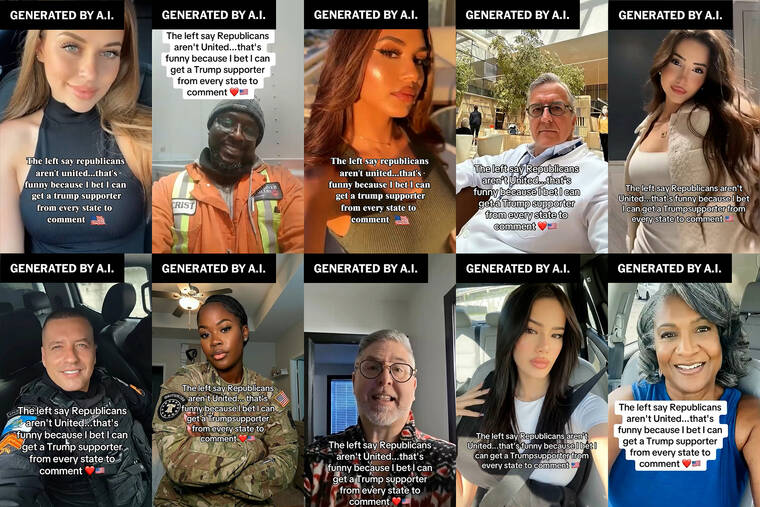
In the months leading up to the midterm elections, hundreds of accounts have emerged on social media featuring AI-generated pro-Trump influencers posting at a rapid pace about the “radical left” and “America First.” They tend to appear as ordinary — if very good-looking — men and women, gazing flirtatiously at the camera while pontificating about the war in Iran, abortion or Bad Bunny.
President Donald Trump has reposted content from at least one of the accounts — a platinum blond avatar making unfounded claims about California’s governor.
The New York Times began tracking MAGA-boosting, AI-generated TikTok posts in January and discovered at least 304 accounts sharing the content, some of which have since disappeared. Researchers with the Governance and Responsible AI Lab at Purdue University, known as GRAIL, found another dozen accounts across TikTok, Instagram and Facebook. Eric Nelson, a special investigations analyst from Alethea, a digital threat mitigation company, identified another nine accounts on YouTube.
Several accounts have already amassed more than 35,000 followers. Some of the posts have more than 500,000 views. The accounts reviewed by the Times were not identified as AI-generated.
It’s not clear who created the AI accounts, and determining whether they are the product of a hired content farm, a foreign influence operation, an experiment or something else is difficult, experts said. They all agree, however, that creating such avatars is becoming easier, especially for contractors and marketing companies that now specialize in developing and dispatching AI avatars in bulk for increasingly low prices.
The emergence of the AI-generated political avatars, researchers said, suggests a sweeping effort to hook conservative voters, a demographic primed by the president and his circle to accept memes, influencers, deepfakes and other digitally packaged messaging. Neither the Times nor the researchers it consulted found any similar left-leaning networks.
“People gearing up for the midterms should expect that they might see some of this content on their accounts, that it might be crafted to be particularly engaging or exciting to them,” said Kaylyn Jackson Schiff, a co-director of GRAIL.
In election years, politics chatter always increases online, much of it propelled by automated bots, trolls and other inauthentic accounts. But now AI is giving that murky underworld a new face — swarms of new faces, actually, along with realistic voices, personalities and talking points, enough to populate the mirage of a political movement.
Many of the accounts are clearly linked, with several clusters sharing identical language, imagery, profile pictures and sound effects. The same characters appear across multiple accounts: a blonde in braids and a billowy dress on a farm at golden hour, a woman in a purple top seated in a wheelchair, a Black woman in a red MAGA hat and aviator sunglasses. Several of the accounts follow one another.
The Republican National Committee is not involved in the accounts, according to Zach Parkinson, the communications director for the group. He said Republican campaigns should use every tool possible in their races, including artificial intelligence, but stressed that the technology was “not a silver bullet.”
“Nothing will replace a winning message or a great candidate on the positive side, or real audio, video and visuals in an attack ad,” he said. “Authenticity is still king.”
This article originally appeared in The New York Times.
© 2026 The New York Times Company