Clayton Kershaw gets standing ovation after final regular-season start at Dodger Stadium
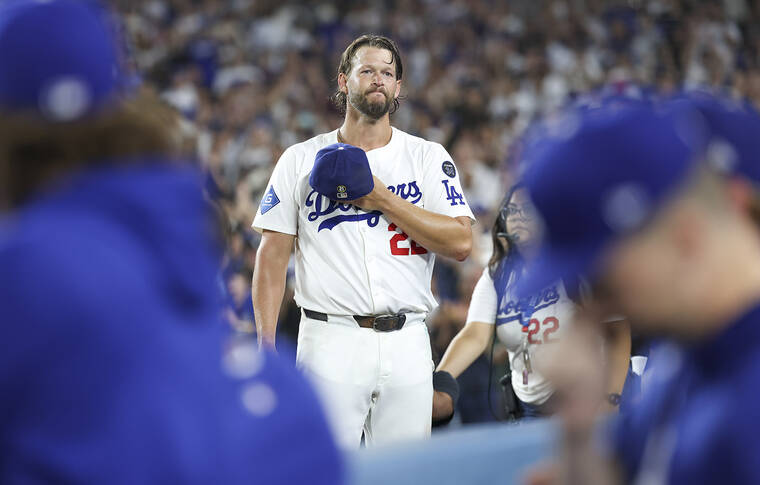
LOS ANGELES — At 3:28 p.m., Clayton Kershaw walked through the Los Angeles Dodgers’ clubhouse. Wearing a hooded sweatshirt and sneakers, the man who for a generation personified a franchise and carried the hopes of a city, went about his work one more time. Friday marked the last time he will ever start a regular-season game at Dodger Stadium, but the retiring Kershaw still, always, had his routine.
It was the routine centered around every fifth day that charted this path towards being perhaps the best pitcher of his generation. It was that routine that president of baseball operations Andrew Friedman urged every young pitcher who followed Kershaw to watch and to follow. Veterans and prospects alike turned to watch him, hoping to extract something repeatable. No one did it like Kershaw, for whom time mattered above all.
ADVERTISING
At 6:23 p.m., Kershaw exited the Dodger dugout and strolled towards the bullpen. A crowd that had watched him from the time he was 20 years old rejoiced. Few pitching prospects have come with as much hype as the Texan with a 97 mph fastball and a curveball that Vin Scully coined as “Public Enemy No. 1.” Even fewer lived up to it.
Before his cleats hit the dirt, Kershaw looked up to where his wife, Ellen, and family sat, and blew a kiss. He and catcher Dalton Rushing took the field first to soak in the reception and raise his arm to the crowd before his teammates joined him. A packed stadium stood as Kershaw’s song started at 7:08 p.m. “We Are Young,” Kershaw is no longer. He is 37 years old now, with flecks of gray in his beard and four kids, with a fifth on the way. He’s averaged 89 mph on his fastball this season, as after two years marred by shoulder, knee and toe surgeries, he’s found a way once again to be productive and make it all work. His first pitch to the San Francisco Giants’ Heliot Ramos registered at 88.7 mph.
It was fitting that Kershaw’s last start at home came against the Giants, whom he had faced more than any other team (62 outings) and dominated to a 2.08 ERA in his career.
“All we need is Buster in the lineup, hitting third,” manager Dave Roberts said. Enough time has passed that Buster Posey is now running the Giants’ baseball operations department. Kershaw’s rookie season in 2008 represented Roberts’ final year in the big leagues.
Kershaw was just a kid then. The slider that carved up hitters for nearly two decades wasn’t even part of his arsenal yet, as it was when he fired one that dove into the dirt to Willy Adames to record his first strikeout on Friday. It was better than the previous slider he threw, which Ramos sent into the seats for a leadoff homer.
He worked around a pair of walks in the second inning, getting a pair of popups to get a scoreless frame under his belt. Kershaw struck out Rafael Devers on another slider to lead off the third before a Matt Chapman double and Wilmer Flores single pushed across a second run against him before Kershaw induced a double-play ball to get out of it. Edgardo Henriquez stood up to start warming up as soon as the Giants’ order turned over a third time for the game in the fourth inning. Kershaw capped off that inning with another slider to fan Adames.
Henriquez warmed again as Kershaw took the mound for the fifth, drawing a cheer from a crowd sensing the end. They roared when they thought Kershaw had strike three against Devers on a fastball over the plate. They erupted again two pitches later when Kershaw froze Devers with an 89 mph fastball at the knees. Roberts stood at the top step as Kershaw exchanged hugs with his infield mates before coming to grab the baseball. The two lingered around the mound before Kershaw left the Dodger Stadium mound in the regular season for the final time.
He looked again up to Ellen and his family gestured to the sold-out crowd before retreating to the dugout. A curtain call was in order, and Kershaw obliged.
The line on Kershaw’s 228th regular season start in this park: 4 1/3 innings, four hits, two runs, four walks and six strikeouts on 91 pitches. His final career ERA here: 2.26.
The fans who witnessed that young version of Kershaw watched him blossom. He won a Cy Young Award in 2011, then again in 2013 and 2014, dominating so much that final year that he also took home MVP honors that fall and threw his only career no-hitter. During his peak from 2010 to 2015, Kershaw totaled anywhere between 198 1/3 to 236 innings, taking on mileage that he’s worn over time. With his success came responsibility. With his longevity came perspective. The Dodgers have evolved into a juggernaut over his 18 seasons, as fan favorites from Andre Ethier to Russell Martin to Chase Utley to AJ Pollock and longtime catcher Austin Barnes made their way to the ballpark Friday to witness his start, all wearing Kershaw jerseys. The list of future Hall of Famers he’s called teammates has only grown.
None resonated like Kershaw. To those who went to the Chavez Ravine, Kershaw was theirs. He was their ace. And as the Dodgers failed to break through in October, he was the face of their postseason failures. The image of Kershaw, face down on the dugout bench, came to define the exits. The five-run fifth inning against the St. Louis Cardinals in 2013. Matt Carpenter and Matt Adams in 2014. The fever dream that was Game 5 of the 2017 World Series. The home runs Juan Soto and Anthony Rendon hit off him when he entered in relief in 2019. The six-run first inning against the Arizona Diamondbacks in 2023.
Kershaw wore that, fair or not.
“I think that narrative,” Friedman said, “is so off-base. “You look at Kersh and the great starts he’s had in October, how much he’s come back on short rest, how much he got left out longer than he should have because bullpens weren’t as good as what people felt like he would do, and left out there longer than you should have. You never heard one peep about it from him. I think so much of that has clouded the overall body of work that, when we had big games and he was rested, there was nobody we’d rather have on the mound than Kershaw.”
“Especially when you look back at the circumstances of some of the things that happened — whether it’s the 240 innings or pitching on very short rest multiple times in a postseason and never running from that, that responsibility as the ace,” Roberts said. “With that, you’ve got to take on a lot of scrutiny or potential failures. Everything wasn’t optimal for him.”
That made 2020 worth it. When the Dodgers broke through that season, Roberts thought of the image of Kershaw with his hands on his head, a combination of relief and disbelief. That is why, when the Dodgers won it all last October and finally got a parade, emotion broke through for him. It was the crowd’s moment with him, a chance to cleanse all the pain they’d felt together.
“He’s laid everything out there on that mound,” Freddie Freeman said.
“He would take the ball when it was his turn, and he would also take the ball when it wasn’t his turn, coming out of the pen, doing anything the team asked of him,” Max Muncy said. “He never said no.”
Friday, a crowd that went through it all with him got a chance to say goodbye.
This article originally appeared in The Athletic.
© 2025 The New York Times Company