Trump’s doubling of tariffs hits India, damaging ties
WASHINGTON/NEW DELHI — President Donald Trump’s doubling of tariffs on imports from India to as much as 50% took effect as scheduled on Wednesday, delivering a serious blow to ties between two powerful democracies that had in recent decades become strategic partners.
A punitive 25% tariff, imposed due to India’s purchases of Russian oil, was added to Trump’s prior 25% tariff on many imports from the South Asian nation. It takes total duties as high as 50% for goods as varied as garments, gems and jewellery, footwear, sporting goods, furniture and chemicals – among the highest imposed by the U.S. and roughly on par with Brazil and China.
ADVERTISING
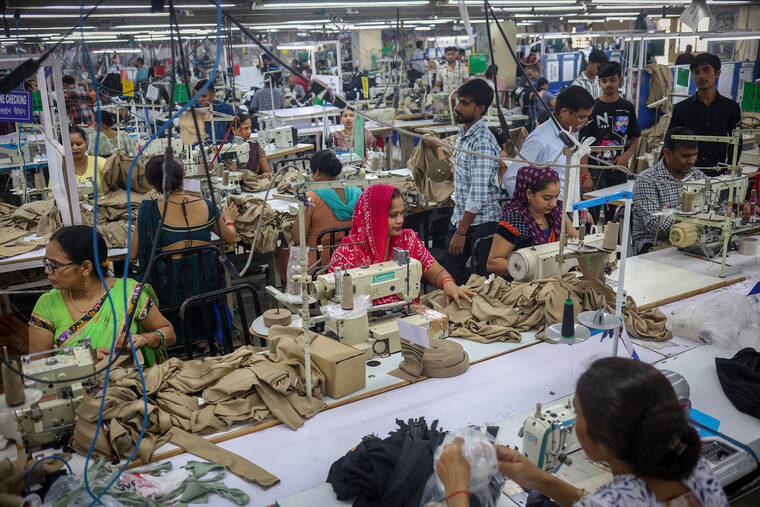
The new tariffs threaten thousands of small exporters and jobs in India, including in Prime Minister Narendra Modi’s home state of Gujarat, and are expected to hurt growth in the world’s fastest-growing major economy.
There was no indication of renewed talks between Washington and New Delhi on Wednesday, after five rounds of talks failed to yield a trade deal to cut U.S. tariff rates to around 15% – like the deals agreed by Japan, South Korea and the European Union. The discussions were marked by miscalculations and missed signals, officials on both sides say.
India’s trade ministry did not immediately respond to a request for comment. But an Indian government source said New Delhi hoped the U.S. would review the extra 25% tariff, adding that the government plans steps to help cushion its impact.
There was no Indian market reaction to the move on Wednesday as markets were closed for a Hindu festival, but on Tuesday equity benchmarks logged their worst session in three months after a Washington notification confirmed the additional tariff.
The Indian rupee also continued its losing streak for a fifth consecutive session on Tuesday, ending at its lowest level in three weeks.
While the tariff disruption would be bruising, it may not be all gloom and doom for the world’s fifth-largest economy if New Delhi can further reform its economy and become less protectionist as it seeks to resolve the crisis with Washington, analysts said.
A U.S. Customs and Border Protection notice to shippers provides a three-week exemption for Indian goods that were loaded onto a vessel and in transit to the U.S. before the midnight deadline.
Also exempted are steel, aluminum and derivative products, passenger vehicles, copper and other goods subject to separate tariffs of up to 50% under the Section 232 national security trade law.
Indian trade ministry officials say the average tariff on U.S. imports is around 7.5%, while the U.S. Trade Representative’s office has highlighted rates of up to 100% on autos and an average applied tariff rate of 39% on U.S. farm goods.
White House trade adviser Peter Navarro said India must simply stop buying Russian oil to reduce U.S. import taxes.
“It’s real easy, that India can get 25% off tomorrow if it stops buying Russian oil and helping to feed (Russia’s) war machine,” Navarro told Bloomberg Television.
Washington says India’s purchase of Russian oil helps fund Moscow’s war in Ukraine and that New Delhi also profits from it. India has rejected the accusation as a double standard, pointing to U.S. and European trade links with Russia.
China remains a top buyer of Russian oil, but Trump has said he does not immediately need to consider similar extra tariffs on Chinese goods amid a delicate U.S.-China trade truce.
Commenting on the punishing levy, India’s junior foreign minister Kirti Vardhan Singh told reporters: “We are taking appropriate steps so that it does not harm our economy, and let me assure you that the strength of our economy will carry us through these times.”