Divided court eliminates Trump’s half-billion-dollar fine in fraud case
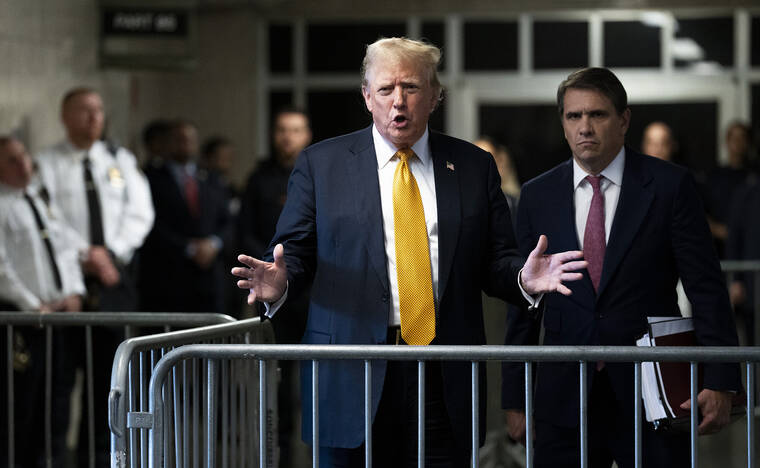
NEW YORK — The massive penalty against Donald Trump in a New York fraud case last year, when he was a candidate, came at what in retrospect looks like the latest nadir in a lifetime of extreme financial swings.
And the appeals court decision Thursday to throw out that judgment may mark the apex of his most recent upward surge, this one launched, and at least partially fueled, by his clinching of the Republican nomination for president last year.
ADVERTISING
The case was brought by Attorney General Letitia James of New York against Trump and his family real estate business in 2022, accusing them of inflating his net worth to obtain favorable loan terms. After a monthslong trial, the judge overseeing the case ruled last year that Trump was liable for conspiring to commit fraud.
In a lengthy ruling, an appeals court upheld the fraud conviction Thursday but threw out the half-billion-dollar judgment against him. Trump and the Trump Organization hailed the ruling, saying they had been the target of a political witch hunt. Trump praised the court in a social media post for having “the Courage to throw out this unlawful and disgraceful Decision.”
Still, thousands of pages of internal Trump Organization documents filed in the lawsuit showed signs of deep financial trouble within the family company — further revealing the business problems that had long dogged Trump’s self-assigned image as supremely successful.
His office building in lower Manhattan was not earning enough to cover its mortgage, and a roughly $100 million balance was coming due. Many of his golf courses had often not covered costs. His last two major real estate projects — a hotel in Washington and a tower in Chicago — had been money losers.
In the biggest hit to his bottom line, Trump was no longer receiving the tens of millions of dollars a year that had once come his way as a television celebrity, money that had propped up his other businesses.
Trump’s cash on hand, the records showed, had swung wildly in recent years, hitting a low for all his personal and business accounts of $52 million in 2018, a small figure for the size of his operation.
By late 2023, when Trump testified in the attorney general’s case, he boasted of having between $300 million and $400 million in cash, which he said showed “how good a company I built.” But his own records showed the figure had increased in large part by selling off money-losing assets, not from thriving profits.
Either way, the penalty of about $450 million levied in the lawsuit would have more than wiped out all of Trump’s cash and likely forced a fire sale of one or more of his properties. The penalty represented what the judge determined to be the ill-gotten gains that the Trumps collected through lower interest rates and other benefits.
But after he clinched the 2024 Republican nomination, Trump and his eldest sons, Donald Trump Jr. and Eric Trump, undertook a series of moves that would avoid those outcomes, and also, at least implicitly, monetize the presidency.
The Trumps redirected their energies away from the family’s historical base of real estate and golf to form new partnerships, most significantly in cryptocurrency, that required little work or investment from them but quickly provided hundreds of millions of dollars in income.
Those moves are already paying off. His crypto assets could be worth as much as $7.1 billion and he has collected at least $620 million from those ventures, The New York Times calculated last month.
Earlier this month, Trump filed an update to his required financial disclosure reports showing that he had purchased tens of millions of dollars in stocks and bonds this year.
© 2025 The New York Times Company