‘We’re ready to go’: After 8 long years, lower Puna residents are eager to drive home
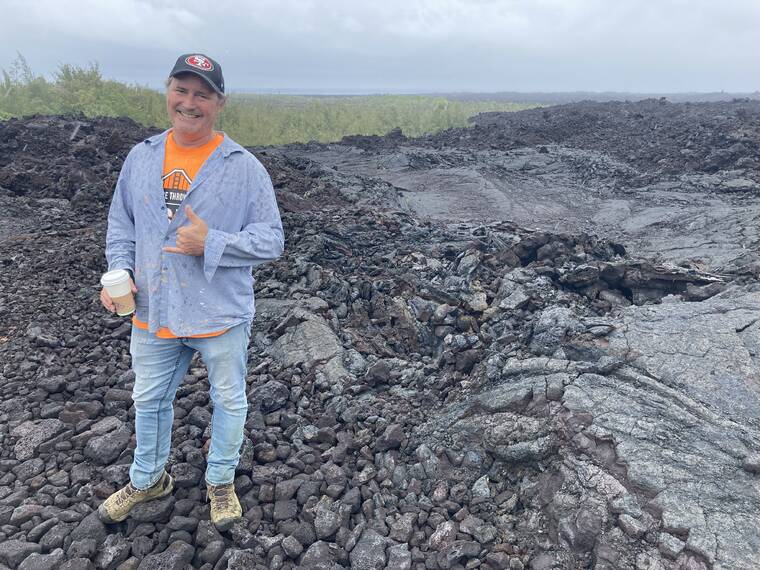
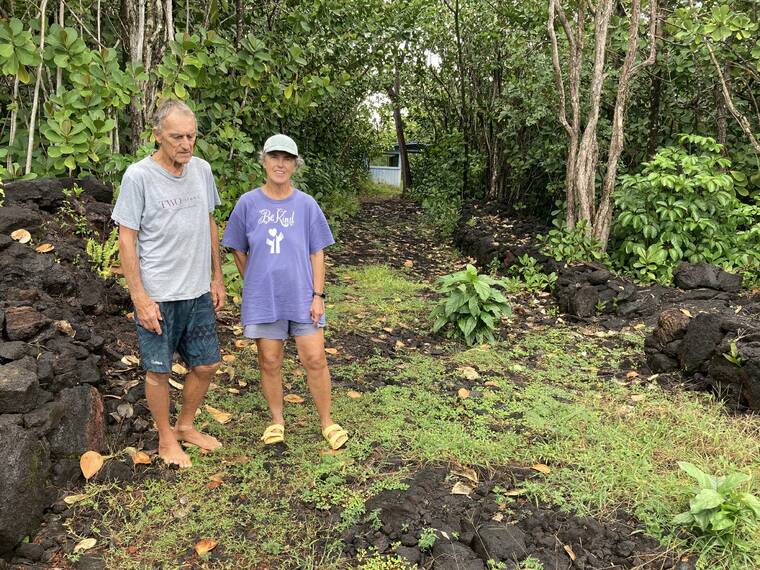
After seven years of hardship and anxious waiting, 71-year-old Deb Smith and her 72-year-old husband, Stan, should finally be able to drive home by the end of this year.
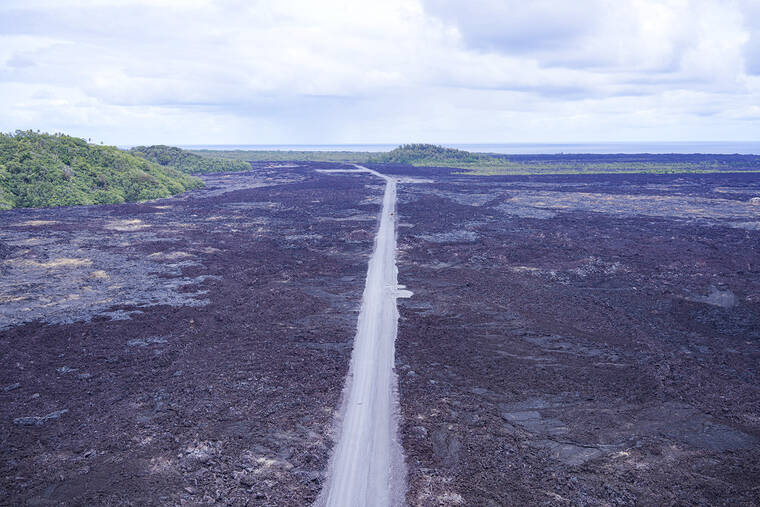
The Smiths have been living at their 5-acre Kapoho Farm Lots property for over half a decade, coming and going via bicycle, hauling groceries, building materials and off-grid supplies over a treacherous, rocky 700-foot trail traversing mounds of black lava cinders at the border of the 2018 lava field.
ADVERTISING
Once across the jagged footpath, it’s another mile ride down a surviving section of the sandy, washed-out Lighthouse Road to get to their house. Add this to the fact that they’re forced to leave their vehicle at a friend’s property located a mile and a half up the hill from the highway intersection, and a trip to Pahoa quickly becomes a daunting prospect.
“It’s three miles from here to get to our car,” Deb Smith said, adding up all the different legs of the journey. “It’s an ordeal for us to go, we don’t just go out on a whim.”
But relief for the kupunas is fast approaching.
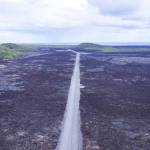
Construction crews from Isemoto Contracting are on-schedule to complete a 3.6-mile rebuilt section of lava-covered highway in Kapoho later this year. This will connect the intersection of Highways 132 and 137 — locally known as “Four Corners” — with Isaac Hale Park, Pohoiki Beach and the communities of Opihikao and Seaview Estates farther south, reopening the Kapoho-Kalapana road for the first time since the 2018 Kilauea lava flows.
According to county officials, waterline installation along the rebuilt highway segment is nearly complete, and aggregate subbase and base course are being laid in anticipation of paving, which is scheduled to start this month.
Inundated sections of Pohoiki Road are slated for reopening by the middle of next year, where another community of displaced residents eagerly await safe, reliable access to their surviving homes and land. For that project, rough grading is ongoing in the lower section, while gravel is starting to be laid in the upper section, with waterline installation beginning soon.
Crews have encountered temperatures topping 150 degrees after excavation, forcing them to place waterlines in an open trench in some sections rather than burying them.
Both roads will be two-lane (one in either direction) with 5-foot-wide paved shoulders and additional 5-foot-wide unpaved shoulders.
Although Highway 137’s reopening will get them close, the Smiths’ homecoming will still require a bulldozer grading several local Kapoho roads before access to all the subdivision’s privately owned lots is fully reestablished. But Deb Smith is confident this will only take a few months, and much of the legwork has already been done: money has been secured, grading permits are in place, surveying is complete, and the contractor is lined up.
The majority of funding to open the local roads comes from $500,000 in Kilauea Recovery Grant Program money awarded in March. The program is a Hawaii County initiative supporting recovery, resilience and economic revitalization projects in lower Puna in the wake of the 2018 eruption. Deb Smith estimates that two-thirds of local road grading will be paid for with the grant funds, with the remainder covered by a Small Business Administration loan.
‘We’re ready to go,” she said.
The Smiths have held on so long despite the isolation and arduous commute because, since the earliest days of their impossible situation, they’ve been told by county officials that help is on the way.
“We hauled tons of stuff out here, big grocery loads. I can’t tell you how many wheelbarrow trips I’ve done,” Stan Smith said. “I’ve hauled lumber out here, two or three loads a day over my shoulder, just to get stuff done. Because they kept telling us ‘yeah, we’ll have a road for you in six months or eight months or a year,’ and we kept believing them.”
During the eruption, lava covered most of the Smiths’ original Kapoho property, destroying their home and several acres of land. In 2019, they bought their neighbor’s lot which still had a few standing, livable structures, and figured they’d hang on until road access — as promised by then-Mayor Harry Kim — was established.
“It’s because the county told us there was gonna be a road ready,” Stan Smith said. “I remember it being six months, so we thought, well, we’ll come out here and work hard for a month or two and get this ready, and we’ll have a road and fricken go for it. We thought, oh, we’ll just move out here, we’ll just rough it for a few months until they get the road open.”
If they would have known from the start that this process would take this long, Stan Smith said, they would’ve given up.,
“We wouldn’t have bought this. We’d be somewhere else,” he said. “We were living up in Kapaau up north for almost a year, and we were looking for something to buy up there, and the lava quit and left our land. It took our house and left our land. So, we said let’s just go for it — huge mistake. If I ever had to do it again — no way, not with this county.”
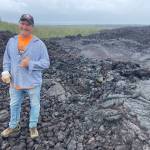
Another displaced Kapoho Farm Lots resident eager to return home is Eric Cockcroft, a retired Pahoa High and Intermediate School teacher who co-founded of the Hawaii Academy of Arts and Science Public Charter School. Since 2018 he has lived comfortably in HPP and Waimea, but always longed for a return to the place where he raised his family and lived for 30 years.
Most of Cockcroft’s 5-acre property — including his house — was covered by lava in 2018, with roughly one acre spared.
“It’s been eight years, and I’m ready,” Cockcroft said. “I’ve been ready to pull the trigger on this thing for eight years. I know exactly what to do, I know exactly how to do it. My place is going to be incredible.”
His excitement at the idea of returning, he said, is tempered by the bitterness felt toward those responsible for his continued displacement.
“I’ll have a spot for my grandkids to legacy,” he said. “And go to the beach. That’s the plan, and it’s been the plan the whole time. It never changed; the only thing was the information I got was that it’ll be soon. But it wasn’t soon, and that’s the trauma that I carry with me. They took years of my life, and every day they take another day that I can’t go home.”
He said he plans to rebuild his house and restart his palm farm business.
“I’m gonna come home, and I’m gonna put my farm back together, and gonna put my house back up, and my son is gonna bring his horses down, and it’s gonna be a ranch, and it’s gonna be beautiful,” he said. “My son and my grandsons and I and our families are gonna live our days out there. Home — we’re gonna be home.”
Email Stefan Verbano at stefan.verbano@hawaiitribune-herald.com.