With Hawaii’s cost of living ranking among the highest in the nation, state leaders are accelerating public preschool and child care subsidy expansions aimed at helping working families afford early education.
New economic data show that even as wages rise, they are not keeping pace with basic living expenses — and child care alone can rival or exceed monthly rent. State leaders say recent public preschool and subsidy expansions are designed to close gaps, but access — especially for infants and toddlers — remains a major challenge.
A recent SmartAsset analysis of Massachusetts Institute of Technology living wage calculator data, reported by CNBC, found that Hawaii requires the highest income in the nation for a single working parent supporting a non-working partner and one child — at least $102,773 per year. It is the only state where a three- person household requires a six-figure salary to cover basic needs such as rent, food and health care. The estimate excludes discretionary spending.
If both parents work, the required household income rises to at least $115,814 annually when child care is included. By comparison, Hawaii’s median household income is just over $98,000, according to U.S. Census Bureau data.
At the same time, federal labor statistics show that wages in Hawaii trail national averages. According to the U.S. Bureau of Labor Statistics, Honolulu County’s average weekly wage rose 6.5% over the year to $1,412 in the first quarter of 2025 — ranking 144th nationally among large counties and still below the U.S. average of $1,589. Neighbor island counties reported even lower weekly averages: $1,226 in Kauai, $1,215 in Maui County and $1,183 in Hawaii County.
Child care costs add another layer of financial strain.
Data compiled by child care platform TOOTRiS show the average annual cost of infant care has reached $24,115 — about $2,010 per month — while care for a 4-year-old averages $13,992 annually, or about $1,166 per month. In Honolulu, estimates place monthly child care costs even higher, with infant care around $3,045 per month and general child care around $2,796 — compared with roughly $2,200 for a one-bedroom apartment.
That means child care can run about 27% more than rent and consume roughly 40% of a typical Honolulu household’s median monthly income of about $7,076. Infant care alone can take up about 43%. For a median-income Hawaii family of four earning $137,454 per year, infant care represents nearly 17% of gross household income — more than double the 7% affordability benchmark recommended by the U.S. Department of Health and Human Services.
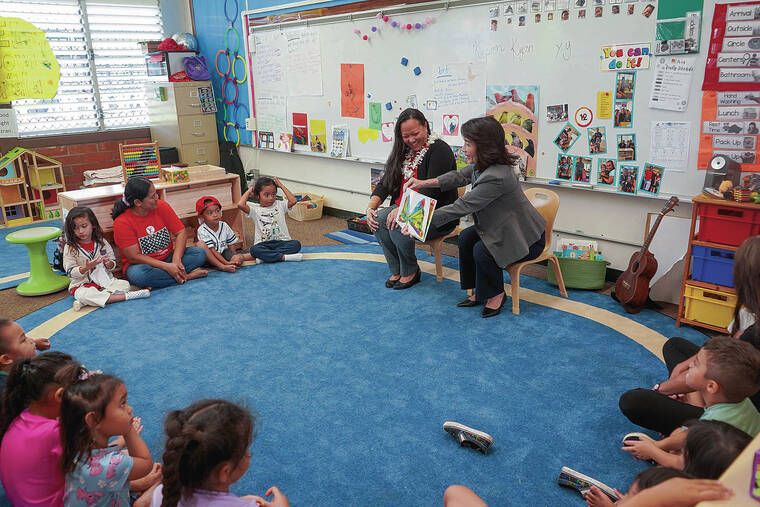
Lt. Gov. Sylvia Luke said high child care costs were a central driver behind the state’s Ready Keiki initiative and public preschool expansion.
“The entire Ready Keiki initiative and the preschool expansion was to address the cost of living,” Luke said in an interview. “Child care ranked as one of the top cost drivers for many families.”
Luke said monthly preschool and child care costs often range from $1,200 to $1,500 and can exceed $2,000 in urban areas. For families with more than one child under age 5, costs can surpass $4,000 a month — more than many mortgage or rent payments.
“It’s pretty rare to have a stay-at-home parent in Hawaii,” she said. “Our working families are the ones investing in the state and our future. We need to do our jobs and look at different ways of defraying their costs and reducing their burden.”
State efforts have focused on both free public pre-K seats and expanded subsidies for private and nonprofit providers. The Preschool Open Doors program — which provides tuition subsidies — has grown from serving about 500 families in earlier years to roughly 3,500 families now, after lawmakers broadened eligibility and allowed year-round enrollment. Income eligibility has expanded to households earning up to $180,000 for a family of four, with some families paying as little as a $50 monthly co-pay instead of full tuition.
Lawmakers have appropriated about $50 million annually for the program, and officials say they are working to fully deploy those funds after past rules limited how much could be spent.
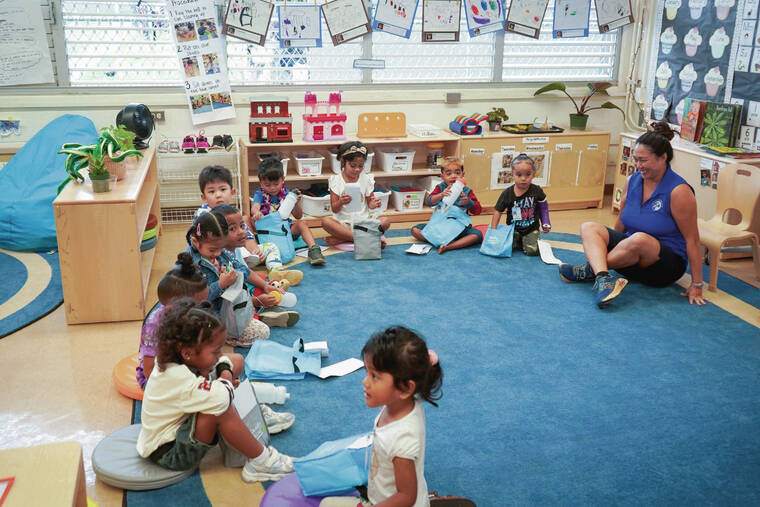
Yuuko Arikawa-Cross, director of the state Executive Office on Early Learning, said demand for free public pre-K continues to far exceed available seats. The office operates 117 classrooms across 89 campuses statewide with capacity for about 2,275 children. As of February, it had received more than 5,100 applications.
“That really shows that there is a great need and demand for a free public pre-K education,” she said.
The state is on track to meet its 2027 goal of creating enough seats for 50% of previously unserved 3- and 4-year-olds and aims to reach full access by 2032. Part of that progress, Arikawa-Cross noted, is tied not only to seat expansion but also to a shrinking child population. Hawaii’s population — and birth rate — is declining by roughly 1.97% annually, narrowing the gap between supply and demand.
Still, major gaps remain — especially for children under age 3, where care is most expensive and least available.
“A need that still continues to exist out there is for infant and toddler care,” Arikawa-Cross said, though new centers have recently opened on Kauai and in Ewa.
Geographic access is another challenge. While Molokai and Lanai have largely closed their preschool access gaps, other communities — including rural and West Oahu areas — remain underserved. The state is adding 25 new public pre-K classrooms next school year, pending site approvals and facility upgrades, and is exploring “hub” campuses where space allows.
Workforce pathways are also tight. Although most public pre-K classrooms are staffed, licensing requirements and limited state- approved teacher education programs create bottlenecks for early childhood educators seeking full credentials.
Officials say the expansion is designed to preserve family choice — whether through free public pre-K, subsidized community- based programs, Head Start or family-child interaction learning programs that support caregivers at home.
Arikawa-Cross said the broader goal is to reduce what she called a forced trade-off between career stability, child development and financial survival.
“Early learning systems reduce that forced trade-off between career stability, child development and people’s financial survival,” she said. “So children can be in stable learning environments … families can remain employed and continue to live in Hawaii.”