Arguments wrap up over steep increase in regulated interisland shipping rates




A quasi-judicial hearing over a proposed steep hike for regulated interisland ocean cargo rates ended Thursday after four days of witness testimony, tough questions and sometimes contentious arguments.
The state Public Utilities Commission will render a decision, anticipated by the end of the year, on how much of an increase is deserved by the financially listing carrier Young Brothers LLC.
ADVERTISING
Young Brothers seeks a 26% boost, and also wants automatic annual raises based on inflation.
The state Consumer Advocate opposes the annual adjustment, and argues that the company’s proposed general rate increase is too high.
During roughly 16 hours of testimony and questioning of mostly Young Brothers executives and consultants, commissioners probed company decisions and claims as attorneys representing the carrier, the Consumer Advocate and the PUC occasionally clashed.
One skirmish led off the second day of the hearing Tuesday, with Jeff Ono, an attorney representing Young Brothers, objecting to cross-examination of local economist Paul Brewbaker by Edward Knox, an attorney representing the state Division of Consumer Advocacy.
Knox hadn’t listed Brewbaker, a paid consultant for Young Brothers, as someone to cross-examine based on Brewbaker’s written testimony. But Knox wanted to question the economist based on related material raised during the proceeding’s first day.
Ono alleged that Knox was sandbagging. “He’s waived his right to cross-examine the witness,” Ono told the three-member commission chaired by Leo Asuncion Jr.
Knox noted that there was no objection in a similar situation a day earlier with another Young Brothers witness. “I’m curious why there’s an objection coming up for Dr. Brewbaker now,” Knox mused.
Ono, in response, declared, “I can selectively choose to object to whatever witness I choose to object to. But you can’t keep cross-examining witnesses that don’t appear on your witness list.”
Asuncion allowed Brewbaker’s cross-examination, which delved into a cargo volume forecast model and price elasticities.
Later on the same day, Ono objected to a chart presented by Julia Verbrugge, an attorney representing the PUC. The chart showed Young Brothers net income before interest expense, and was made by PUC staff using Young Brothers data.
“I think it’s inappropriate and improper for the commission to be slipping anything into evidence,” Ono said. “That’s for the parties to do. It’s for the commission to be the decision-maker.”
PUC member Naomi Kuwaye allowed use of the chart, which showed that the metric shifted from pre-interest profit in 2022 to losses from October 2023 to January 2025 due to rising expenses and flat revenue.
Throughout the hearing, much was made of hefty Young Brothers investments in equipment amid financial difficulties, dividends paid to its parent company, efforts to control labor costs, and allocation of costs between regulated and unregulated business lines, among other things.
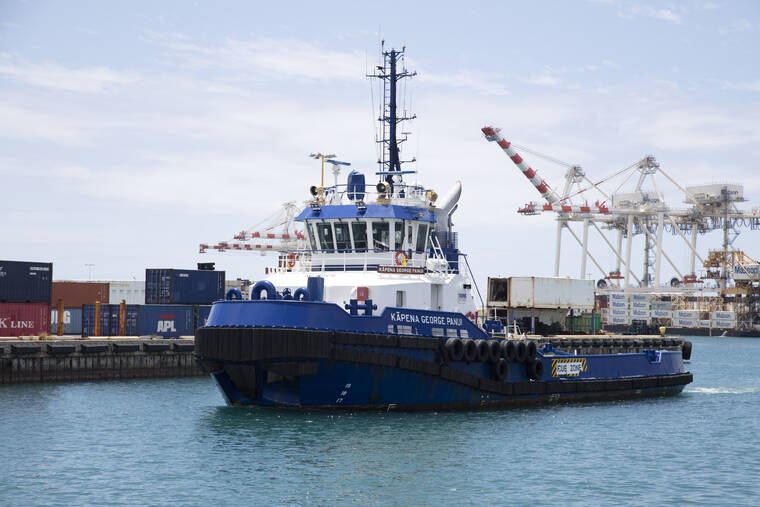
One of the largest drivers of the proposed rate hike is $74 million Young Brothers spent to buy two new barges and two new tugboats put into service at the end of 2024.
Young Brothers executives contended that the investments improve reliability, which helps revenue, while also lowering maintenance costs, eliminating safety risks with old equipment and making operations more efficient.
Kuwaye questioned whether such spending was prudent by Young Brothers, which reported a $14 million loss in 2024 and projects a $25 million loss this year.
“It’s like a new car,” Kuwaye said. “I’d like a new car, but would I buy two new cars when I’m in financial distress? That’s the question, right? Is that a good business decision?”
“At the time that we actually made the decision, it was a good decision,” responded Kris Nakagawa, the company’s vice president of external and legal affairs.
Kuwaye also questioned whether customers paying regulated rates are subsidizing the $49 million price for the new barges that Young Brothers also uses to provide unregulated service that includes charters.
“That’s basically something that the regulated customer is paying for, the barges, correct?” Kuwaye said. “A portion of it.”
Nakagawa replied that revenue from unregulated service helps pay for costs to provide regulated service.
“But for the unregulated services, it would be much more costly to operate the regulated services,” he said.
On the hearing’s third day, Ono asked Michael Starkey whether regulated customers subsidize unregulated customers.
“No,” said Starkey, who as president of QSI Consulting sponsored the carrier’s cost allocation model that accounts for use of equipment minute by minute and fuel consumption between regulated and unregulated service.
Also on the third day, PUC member Colin Yost tried to get a handle on dividend payments Young Brothers has made to its Seattle- based parent, transportation and distribution conglomerate Saltchuk.
The dollar amount of the dividend payments are confidential, but Yost wanted to know from Ashlee Kishimoto, Young Brothers director of finance, if it amounted to more than $20 million.
Ono objected, and no answer was provided.
State Consumer Advocate Michael Angelo is recommending that the PUC initiate an investigation hearing into broad operations and finances of Young Brothers, possibly as a condition of any rate increase approval.
“This is not the first time we’ve been at the precipice of extreme financial dire situations,” he told the commission Thursday. “It’s important that we are able to investigate the entire company to get a better understanding of its overall financial picture and what is driving these continued dire financial situations.”
• • •
Young Brothers last received a general rate increase approval from the PUC in 2020 — a 46% spike based on an emergency request the company said it needed to nearly break even financially and avoid shutting down amid a sharp falloff in business early on in the COVID-19 pandemic.
At the time, the state Consumer Advocate considered the increase excessive. And in 2021, a state-ordered audit said the emergency increase was producing profits for Young Brothers, in part by over-allocating costs to its regulated business versus its unregulated business. The audit also said a strong argument existed for the emergency increase to be reduced.
Young Brothers filed its new rate application Oct. 15, seeking the 26% increase that includes a 20% average increase on most cargo and up to 45% on some service.
As an interim measure, the company asked the PUC in February to approve a general 20% rate increase effective April 1 followed by an additional 5% by July 1. Then in April, Young Brothers applied for annual inflationary increases, and asked for the first one by July.
On June 27, the PUC approved an 18.1% interim general rate increase that took effect July 1.
Ono told commissioners Thursday, in closing remarks to end the hearing, that labor costs driven by collective bargaining agreements heavily influenced by unionized West Cost and Hawaii dockworkers have been the primary driver of rising costs for Young Brothers, and that the company can’t sustain itself without something very close to the 25.75% rate increase it seeks.
Ono said a 25.1% increase would allow the company to break even. “Young Brothers needs every penny of this rate increase,” he said. “That’s the evidence. Thank you.”