
Netanyahu and Trump back deal; Hamas says it wasn’t at table
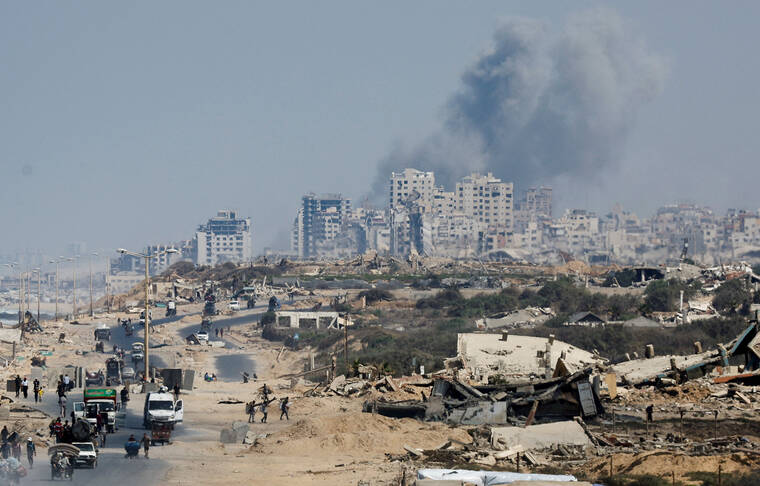
Prime Minister Benjamin Netanyahu of Israel said Monday that he supported a 20-point plan released by President Donald Trump to end the Israeli military campaign in the Gaza Strip, free the remaining hostages and rebuild the devastated territory.
But Trump and Netanyahu, speaking at the White House, both said they would support Israel continuing the war if Hamas rejected the deal. Hamas had no immediate comment on the proposal. And it appeared improbable at best that Hamas would agree to a demand in the plan that it disarm without a full Israeli withdrawal from the territory.
ADVERTISING
Netanyahu said if Hamas did not embrace the proposal, “then Israel will finish the job by itself.” He added: “This can be done the easy way or it can be done the hard way, but it will be done.”
Trump said if Hamas did not agree to the proposal, he would support Israel as it continued its military assault, which has killed tens of thousands of Palestinians. “Israel would have my full backing to finish the job of destroying the threat of Hamas,” Trump said.
Before Trump and Netanyahu spoke, Taher al-Nounou, a senior Hamas official, said in a televised interview Monday that the group had not been involved in developing the plan. “When it comes to this plan, no one contacted us, nor were we part of the negotiations around it,” he said.
Still, Trump expressed hope that the proposal would finally bring an end to the nearly two-year war and create a framework to govern postwar Gaza. It calls for Gaza to be governed by a temporary, “technocratic, apolitical Palestinian committee,” overseen by an international “Board of Peace,” which would be led by Trump and include other world leaders, including Tony Blair, a former British prime minister. Hamas would have no role in governing Gaza under the plan, which the White House released Monday just before Trump and Netanyahu spoke to reporters.
“We’re, at a minimum, very, very close,” Trump said. “And I think we’re beyond very close.”
Netanyahu thanked him for offering the proposal. “I support your plan to end the war in Gaza, which achieves our war aims,” he said. “It will bring back to Israel all our hostages, dismantle Hamas’ military capabilities, end its political rule and ensure that Gaza never again poses a threat to Israel.”
The proposal calls for Israel to pull back its forces to an unspecified “agreed-upon line” within Gaza to prepare for the return of the remaining hostages who were seized during the Hamas-led attack on Israel on Oct. 7, 2023. At least 20 of them are still believed to be alive in Gaza, according to Israel. The bodies of about 25 are also being held in the territory, Israel says. All would have to be released within 72 hours of Israel accepting the plan.
Israel would then withdraw further once an “International Stabilization Force” was ready to step in, and it would “not occupy or annex Gaza,” the plan states. But Netanyahu said Israel would be allowed to maintain a sizable “buffer” zone inside Gaza’s borders “for the foreseeable future.”
Once the hostages were released, Israel would release 250 prisoners serving life sentences as well as 1,700 Palestinians who were detained after Oct. 7, 2023, including all the women and children being held. Hamas members “who commit to peaceful coexistence” and turn over their weapons would be granted amnesty, the plan says; those who chose to leave Gaza would be given safe passage to other countries.
Hamas would have to forsake any role in governing Gaza, have its arms and military infrastructure destroyed and agree to a supervised demilitarization. The proposal’s focus on demilitarizing Gaza presents a challenge for Hamas, which has publicly refused demands that it disarm, describing its weapons as “legitimate” tools to fight Israel.
© 2025 The New York Times Company


