After Charlie Kirk’s assassination, a bumper crop of conspiracy theories
Six days after right-wing activist Charlie Kirk was killed at Utah Valley University, the state’s public safety commissioner, Beau Mason, described the suspect arrested in the case as a “lone gunman.” Mason was careful to note, as law enforcement officials often do in such situations, that the government’s investigation of the Sept. 10 assassination was ongoing.
In the meantime, amateur investigations were proliferating, with different theories of the case.
ADVERTISING
On her online talk show last week, Candace Owens, the far-right provocateur and conspiracy theorist, showed an image of what she claimed to be a “trap door” leading to “a whole underground thing” near the location where Kirk was killed. Owens wondered if investigators had considered that someone may have shot Kirk from below and escaped through a tunnel system.
“I’m theorizing,” Owens said, “because I have a right to. I have a right to think.”
A bumper crop of conspiracy theories — none of which are supported by any evidence — have bloomed in the aftermath of Kirk’s death, turbocharged by social media and America’s online influencer class. They are suggesting shadow actors and hidden motives, and casting suspicion on the working theory of the case: that the suspect, Tyler Robinson, 22, devised a plan on his own to assassinate Kirk because of his right-wing politics.
On the left, the theories tend to support the idea that Robinson was not, as Gov. Spencer Cox of Utah put it, a man with a “leftist ideology.” Some liberals continue to believe that Robinson was a member of the white nationalist “groyper” movement, far to the right of Kirk.
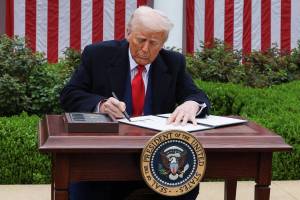
At the same time, some conservatives have been looking for evidence that Robinson did not act alone. Such evidence — which hasn’t borne out — would lend credence to the assertion by Stephen Miller, President Donald Trump’s deputy chief of staff, that there was an “organized campaign that led to this assassination,” involving “terrorist networks.”
Yet another conspiracy — the idea that Israel was somehow involved in the shooting — has become so ubiquitous that the country’s prime minister, Benjamin Netanyahu, recently felt compelled to make a video denying it.
In this case, much of the speculation is being promulgated by conspiracy theorists Kirk himself helped elevate by inviting them to speak at events sponsored by his conservative youth group, Turning Point USA, and other affiliated groups.
Besides Owens, they include: Alex Jones, the host of Infowars; Steve Bannon, the former chief strategist to Trump and host of the “War Room” podcast; and Kari Lake, senior adviser for the U.S. Agency for Global Media. Many are Trump supporters who questioned official government narratives when Trump was out of power, and have continued to do so now that he is back in the White House.
Michael Bitzer, a professor of politics and history at Catawba College, in North Carolina, said conspiratorial thinking has long been a feature of American public life — but that its impact has grown. “What is different today is the spread and the power of these conspiracy influencers to really say whatever they want,” he said, “and it becomes accepted by folks to say this is legitimate.”
Saying they seemed “too stilted, too much like a script,” Bannon recently cast doubt on the authenticity of text messages that authorities released between Robinson and his romantic partner. Bannon also said that the left-wing anti-fascist movement known as antifa should be investigated, as should the possibility that the shooting was connected to the attempted assassination of Trump last year in Butler, Pennsylvania.
Kirk was also a friend of Kash Patel, a promoter of conspiracy theories whom Trump chose to lead the FBI. Patel was invited to speak at a Turning Point event in 2022.
Now some critics are worried that Patel’s handling of the investigation is fueling more conspiratorial conjecture.
Last week, Patel wrote in a social media post that government investigators were looking beyond the “initial findings” of the Kirk investigation. Among other things, he said, investigators were looking into “the possibility of accomplices.”
Patel went on to describe two specific matters that he said the government was scrutinizing, both subjects of much online speculation. One of them, he said, was “hand gestures observed as potential ‘signals’ near Charlie at the time of his assassination.” The other, he said, focused on a plane “that allegedly turned off its transponder after departing from an airport near the assassination site.”
Patel wrote that investigators had determined that the transponder on the airplane was in fact “not turned off,” and that the “apparent gap” was the result of “incomplete flight data in rural areas.”
© 2025 The New York Times Company