Union Station in Washington to go under federal control
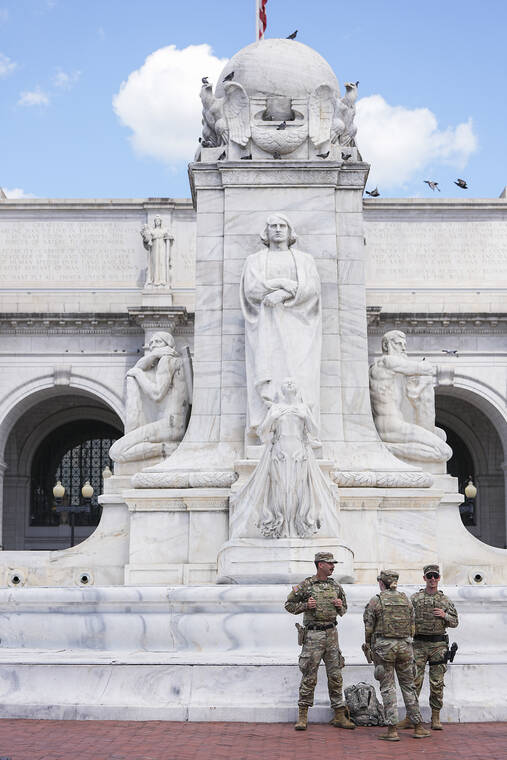
WASHINGTON — Transportation Secretary Sean Duffy announced Wednesday that his department would take control of Washington’s central train and bus hub, Union Station, as part of the Trump administration’s crackdown on the nation’s capital.
“We think that we can manage the property better, bring in more tenants, bring more revenue,” Duffy said, framing the move as part of President Donald Trump’s efforts to tackle crime, remove homeless encampments and invest in beautification projects across the city.
ADVERTISING
“We think we can make this the premiere train station not just in America but the premiere train station in the world,” he added.
It was not immediately clear how and when Duffy would roll out his planned revitalization project, or whether it would use some of the contentious tactics the Trump administration has employed — such as rounding up homeless people — on federally owned land in other parts of the city.
But Muriel Bowser, the mayor of Washington, said that the federal government taking on a larger role in Union Station could be “a very significant and good investment for the region,” particularly if it was comprehensive.
“If it’s about what Union Station needs for its total transformation, that would be an amazing initiative for the federal government to take on,” she told reporters, noting she had discussed Union Station’s needs with the president after his most recent election, before he returned to the White House.
The Transportation Department has owned Union Station since the early 1980s, but had yielded daily operations as well as oversight for its planned upgrades to Union Station Redevelopment Corp., a local nonprofit. In a statement, the department said that it would renegotiate a cooperative agreement with the nonprofit and Amtrak, the national passenger rail service, that would better enable them to generate the money needed to make improvements to the station. Last year, Amtrak took over management and operations of the station under a sublease from the nonprofit. The U.S. government is Amtrak’s controlling shareholder, and the president appoints its board of directors.
The department’s statement indicated that the commercial aspects of Union Station would remain under the direct management of the nonprofit.
Julie Horn, a spokesperson for the Union Station Redevelopment Corp., referred questions back to the Transportation Department. According to the department, the nonprofit’s limited revenue streams had long left it too strapped for the cash necessary to pour needed funds into the commercial infrastructure of Union Station.
In addition to the building’s picturesque, beaux-arts-style central hall, Union Station has a modest three-story mall abutting the transit facilities, but many of its stores closed during and after the COVID pandemic. The department also said that the station’s elevators, lighting and security needed improvement, as well as its roof.
“We are going to make the investments to make sure this station isn’t dirty, to make sure we don’t have homelessness in Union Station,” Duffy said, adding, “We want a place where businesses want to obtain leases and set up shop and serve the community of D.C. but also people who travel into D.C. via train.”
The changes are expected to be formalized in September. It is unclear if they might materially affect a projected $8.8 billion, 13-year renovation plan for Union Station that was finalized last year.
Earlier this week, Trump formally enlisted the Transportation Department to aid in his crackdown on the city, in an executive order instructing Duffy to investigate whether the city was properly ensuring the safety of transit workers, and directing the agency to “take appropriate remedial action that is within the Department of Transportation’s authority” to address lapses.
Since Trump stepped up his crackdown on the capital, there have been National Guard troops spotted in Union Station as well as several subway stations in the downtown area.
This article originally appeared in The New York Times.
© 2025 The New York Times Company