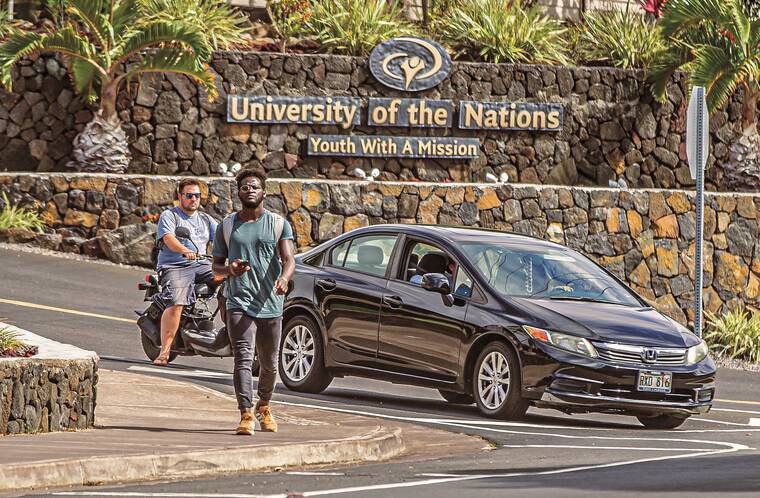
Expansion plans for the University of the Nations in Kailua-Kona have reached a milestone with the release late last month of an environmental impact statement to the state’s Land Use Commission.
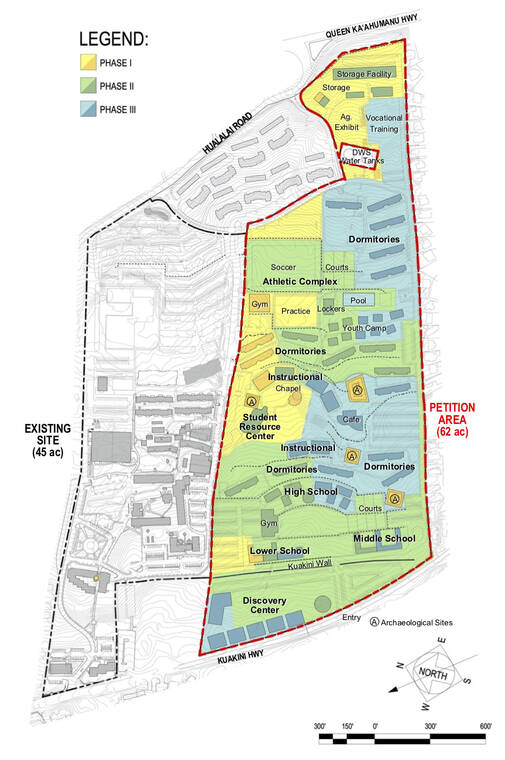
The plans to add 62 acres adjacent to the 45-acre campus on Kuakini Highway have been in the works since a 2003 master plan was submitted to the LUC to change zoning on the two subject land parcels from agricultural to urban.
The consultant preparing the EIS is G70 in Honolulu.
The master plan, if fully developed, would in three phases include additional student housing, academic instruction buildings, a student center, a lower school, athletic facilities, a chapel, maintenance and storage facilities, and supporting infrastructure which includes expansion of the existing central road, an additional secondary access point on Kuakini Highway, and necessary roadway improvements.
Additional water sources and sewer development also would be necessary to support the expansion.
The EIS is subject to LUC approval. The commission will discuss the EIS at 9:30 a.m. Wednesday at the West Hawaii Civic Center.
The U of N Kona also will have to petition the LUC to amend its finding of facts, conclusions of law and decision and order that was issued in the 2003 zoning change before any planned construction can begin.
The U of N Kona, which was established in 1978, is dedicating to educating and training “emerging Christian leaders,” the EIS states.
According to the environmental document, the unaccredited Christian school, which is part of the Youth With a Mission organization, serves about 774 students each quarter, of which about 480 or roughly 62% are college-level. The remainder, just under 300 students, are pre-kindergarten to 12th-grade students, mostly children of students or staff members.
There also are roughly 600 staff members throughout the school year, the document states.
Dorms on the existing campus house between 900 and 1,100 people each quarter, according to the document. All university-level students are housed in campus dormitories.
Phase 1 is based on the school’s projected enrollment and campus needs for the next five to 10 years.
“In the next 5-10 years, enrollment at the U of N Kona campus is projected to increase to a total of approximately 1,058 students per quarter,” the EIS states. “The university-level enrollment is projected to increase to approximately 718 students, accounting for roughly 67% of the total student population. The PK-12 enrollment is projected to increase to approximately 340 students, accounting for roughly 32% of the total student population.”
Phase 1’s expansion — limited to 12 of the 62 acres — would include the construction of an elementary school, chapel, athletic training complex, two dorms and an agricultural exhibit instruction building along with infrastructure improvements including parking and pathways.
The first phase also would implement a preservation plan for the four identified burial sites on the property.
A 2003 burial treatment plan provided an outline for the process.
Phase 2 is based on projections for the next 10 to 20 years.
At that point, “student enrollment is projected to increase to a total of approximately 1,424 students per quarter,” the document states. “The university-level enrollment is projected to increase to approximately 955 students, accounting for roughly 67% of the total student population. The PK-12 enrollment is projected to increase to approximately 469 students accounting for roughly 32% of the total student population.”
Finally, Phase 3 is based on projections for 20 years in the future and beyond.
By then, “student enrollment is projected to increase to a total of approximately 1,775 students per quarter,” the EIS states. “The university-level enrollment is projected to increase to approximately 1,200 students accounting for roughly 67% of the total student population. The PK-12 enrollment is projected to increase to approximately 575 students accounting for roughly 32% of the total student population.”
The Tribune-Herald reached out to U of N but didn’t receive a reply in time for this story.
Email John Burnett at jburnett@hawaiitribune-herald.com.