How Venezuela helps fuel the violence in Colombia
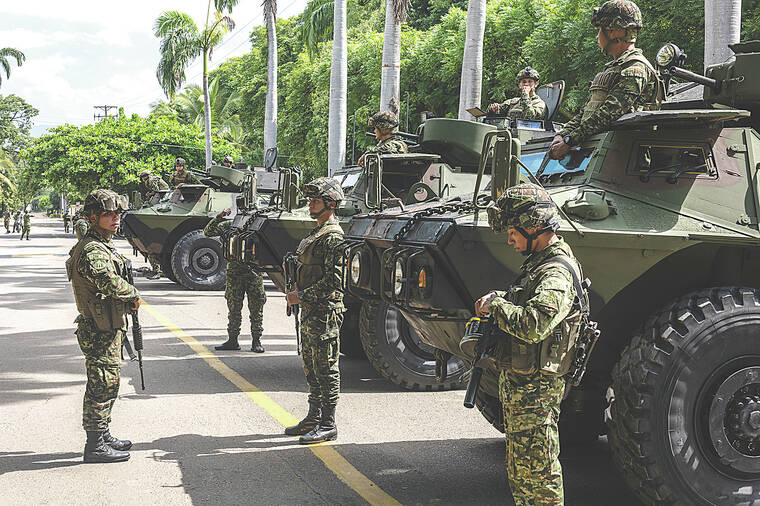
TIBÚ, Colombia — In a remote corner of northeast Colombia, where dirt roads lead to lush hills lined with banana trees, farmers and their families have become the victims of a spate of violence unlike anything the country has seen in a generation.
As two rebel groups battle for territory, more than 54,000 people have fled their homes, and an estimated 80 people died in a matter of days, with the death toll expected to climb.
ADVERTISING
At the root of this conflict are decades-old battles over land and drug money, and the failure of past deals to lead to lasting peace. But analysts, diplomats and even Colombia’s president, Gustavo Petro, point to another, newer factor helping foment the chaos in Colombia: neighboring Venezuela.
Over the past decade, as Venezuela has descended into autocracy, its government has also drawn closer to the principal aggressor in the current conflict next door, a long-standing rebel group called the National Liberation Army, or ELN.
Born as a Marxist group in Santander, Colombia, in the 1960s, the ELN has increasingly used Venezuela as a place of refuge, moving deeper into the country, enriching itself through drug trafficking and other illicit activities, tripling in size to roughly 6,000 fighters and strengthening relationships with Venezuelan officials.
In return, Colombian authorities say, the country’s autocratic president, Nicolás Maduro, who has become more isolated on the global stage, has benefited from having a powerful armed group as a buffer against domestic and foreign threats, including the possibility of a coup.
For years, the disintegration of Venezuela’s democracy has put a strain on neighboring Colombia, sending some 3 million refugees fleeing into the nation of just 50 million.
Now, some say, Maduro’s Venezuela is being used as a base to unleash something far more destabilizing: a new wave of destruction in Colombia.
Petro went as far as accusing the ELN of becoming a “foreign force,” that had invaded Colombia. “This is a problem of national sovereignty,” he said, “not just an internal conflict, which we’ve had since long ago.”
Venezuela’s defense minister, Vladimir Padrino López, in a statement in late January, said it was “essential to state with crystal clarity that Venezuela does not serve, nor will it ever serve, as a platform for armed groups outside the law, whatever their nature, ideology or nationality.”
Why the ELN decided to attack now is unclear, but the relationship between Petro and Maduro, once friendly, has soured significantly over the last few months.
Petro is Colombia’s first leftist president, a former guerrilla himself and seemingly a natural ally of Maduro, who calls himself a socialist. Two years ago, they held a high-profile meeting in Caracas, Venezuela, where the two promised to work together on issues of mutual interest.
That included the security of their 1,300-mile shared border.
Then in July, Maduro declared himself the winner of a tainted presidential election, refusing to produce tallies to back up this claim and imprisoning roughly 2,000 people amid a wave of protest.
The United Nations and other independent monitors questioned the result. The United States recognized the opposition candidate as the winner.
Soon, Petro, one of few leaders to still be somewhat amicable with Maduro, took a more critical tone, publicly urging him to publish election results and release political prisoners. Maduro responded by ordering a “punch in the face” to anyone who meddled in Venezuela’s affairs.
When Maduro was sworn in for a third term on Jan. 10, Petro refused to attend the ceremony or to recognize the Venezuelan as president.
Five days later, the ELN sent fighters from a more southern point in Colombia into northern Colombia, to a strategically important region called Catatumbo, saying on the social platform X that it sought to oust a rival armed group called the 33rd Front.
The two groups had long divided control of the region, home to vast fields of coca, the base product in cocaine. Now, a fragile power-sharing accord had broken.
The violence has crushed Petro’s chances at accomplishing one of his most important policy goals: a peace deal with the ELN, a key part of an ambitious campaign promise — “total peace,” he called it — that he made to end all conflict in Colombia.
Today, tens of thousands of civilians are trapped in the middle of the violence. Some families in Catatumbo have sought refuge in the forest, surviving on whatever they managed to carry with them.
© 2025 The New York Times Company