It’s the final day of a massive health care strike over pay and staff shortages. No deal is in sight
LOS ANGELES — A massive health care strike over wages and staffing shortages entered its final day on Friday without a deal between industry giant Kaiser Permanente and the unions representing the 75,000 workers who picketed this week.
The three-day strike carried out in multiple states is set to officially end Saturday at 6 a.m., and workers were expected to return to their jobs in Kaiser’s hospitals and clinics that serve nearly 13 million Americans.
ADVERTISING
The most recent bargaining concluded midday Wednesday. Additional sessions were scheduled by the parties for Oct. 12 and 13, the unions announced Friday.
The decision to walk off an important job was very difficult, said Josephine Rios, 55, a nurse attendant who takes in patients for surgery at a hospital in Irvine, California.
“Unfortunately, it’s a financial burden for us that live paycheck to paycheck,” she said. “We can’t afford to strike a long time, but it’s a double-edged sword. We can’t afford not to strike.”
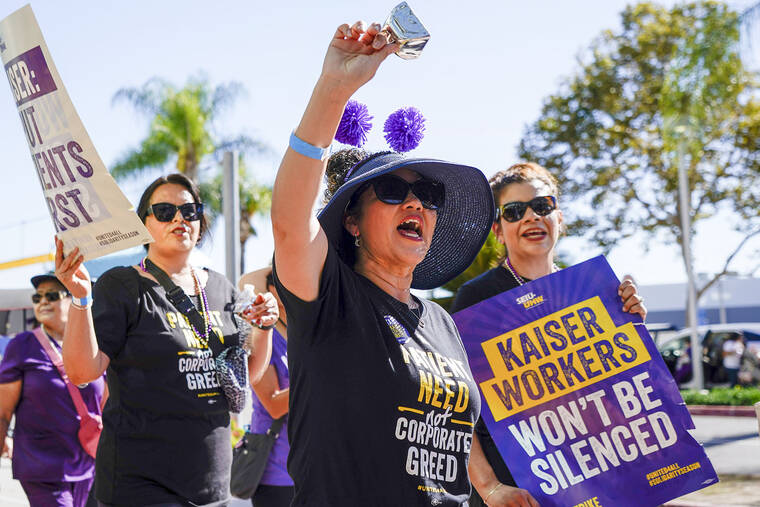
A fall heat wave did not deter picketing at Los Angeles Medical Center in Hollywood, where on Friday the high is 96 degrees Fahrenheit (36 Celsius).
“The energy is high out here today,” said Lakeshia Howze, a unit secretary for the emergency department. “Everybody’s still onboard.”
The strike for three days in California — where most of Kaiser’s facilities are located — as well as in Colorado, Oregon and Washington was a last resort after Kaiser executives ignored the short-staffing crisis worsened by the coronavirus pandemic, union officials said. Their goal was to bring the problems to the public’s consciousness for support, according to the Coalition of Kaiser Permanente Unions. Some 180 workers from facilities in Virginia and Washington, D.C., also picketed but only on Wednesday.
“No health care worker wants to go on strike,” Caroline Lucas, the coalition’s executive director, said Thursday. “I hope that the last few days have helped escalate this issue.”
The company based in Oakland, California, warned the work stoppage could cause delays in people getting appointments and scheduling non-urgent procedures.
Kaiser spokesperson Hilary Costa said the company was working to reconvene bargaining “as soon as possible.”
Unions representing Kaiser workers in August asked for a $25 hourly minimum wage, as well as increases of 7% each year in the first two years and 6.25% each year in the two years afterward.
Kaiser, which turned a $2.1 billion profit for the quarter, said in a statement Wednesday that it proposes minimum hourly wages between $21 and $23.