I was looking at all my hundreds of cookbooks and came across a cookbook, ‘Recipes Uniting Communities’, with ACE Hardware Ben Franklin Crafts employees and friends contributing recipes. It is not quite clear but it could have been a fundraiser for the Maui United Way and I could not find a date when this cookbook may have been published but some recipes are quite timely.
Maui Varieties Limited family is now named House Mart Ace Hardware, Ben Franklin Crafts, and Daiso retail stores. Their beginnings go back to a small local dry goods store, The K. Kamitaki Store, which then became Kahului Dry Goods Store with siblings K. Kamitaki and Matsuko Mizoguchi. The first Ben Franklin store was purchased in 1951, a dream of Tadami Kamitaki. Matsuko kept K. Kamitaki Store thriving by learning to cut patterns and was innovative in producing various styles of aloha shirts. But she was also a great cook who would cook dishes and bring to the store. It was her way of rewarding her employees for their hard work.
Matsuko
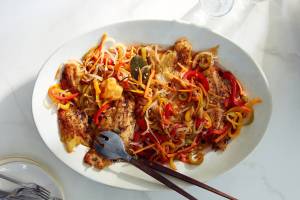
Mizoguchi’s Chicken Hekka
Serves 4-6
Combine sauce ingredients and bring to a boil:
3/4 cup shoyu
3/4 cup mirin
1/2 cup sugar
1/2 cup water
1 package dashi-no moto
Cool.
Arrange in a large skillet:
2 pounds chicken, sliced thin
2 round onions, sliced
2 packs Shirataki (konnyaku noodles)
1 bunch watercress, cut into 1-1/2 inch pieces
1 block tofu, cut into 1-inch pieces
1 small can button mushrooms
16-ounce can bamboo shoots, sliced if whole
Pour sauce over to about 1/2 – inch level. Bring to a boil on high heat, then simmer and cook for 3-4 minutes. Gently mix meat and vegetables to allow the sauce to mix evenly. You may use whatever vegetables you want – gobo or burdock, long rice, noodles, etc.
Grandma’s Manju (Sweet Bean Pastry)
Matsuko Mizoguchi
2-1/2 cup flour
1 block butter
1 block margarine (I am not sure why you could not use 2 sticks of butter and not use margarine)
1/4 cup milk or cream (I think she means evaporated milk)
1 can tsubushi-an (mashed red bean paste)
Remove tsubushi-an from the can or package, make 24-30 balls and add a small bit of butter to the top of each ball.
Cut the butter and margarine in the flour, (mash until no flour is left) and add milk. Separate the dough into two long hotdog style shapes, then pull off or cut the same amount of dough as there are balls of an tsubushi-an in a bowl.
One a clean, smooth surface, sprinkle with flour. Flatten the dough balls in your hard to from circles and place beans in the center of each circle (butter facing down) and pinch edges together to seal. Flatten manju in round circular shapes.
Place on ungreased cookie sheet and brush tops with a little milk. Use red food coloring for the red dot or stamp it. Bake at 400 degrees approximately 20 minutes or until brown on top.
There are little bits of information that are interesting:
Did you know…
• Pineapples were given its name because of its resemblance to pinecones.
• The ancient Aztecs called guacamole “guacamole ahuaca-mulli” which means avocado mixture/sauce. They considered the avocado an aphrodisiac. This may explain some of its popularity with the colonizing Spaniards later on that liked it with either salt, sugar or both.
• In Hawaiian, “poke” means “cut piece” or “small piece.” Poke is bite-size pieces of raw fish doused in seasonings.
• Manapua (char siu bao) a dim sum favorite in Hawaii is a shortening of the Hawaiian phrase “mea ‘ono pua’a” meaning “pork cake.”
• To tell if a papaya will ripen well, take a look at the end where the stalk was. If there is a yellow ring there, it will ripen well. If it’s green, look for another papaya with a yellow ring. Unripened papayas should smell sweet.
• Back in the day, a plate of pineapple on the porch of a New England home meant that a sailor was home and ready to tell tales of his exotic travels.
• Spam means spiced ham. An actor from New York, Kenneth Daigneau, named the now Hawaiian staple after Jay Hormel, father of Spam, held a contest to name it. The actor won $100 in 1936.
• Until the early 1800s in Hawaii, most banana varieties were “kapu” or forbidden for women of Hawaii to eat, under penalty of death.
• Macadamia nut is native to Australia. Aborigines called them “kindal kindal.”
Easter Sunday
This Sunday is Easter Sunday, or Pasch or Pascha or Resurrection Sunday. It is a Christian festival and cultural holiday commemorating the resurrection of Jesus from the dead. The week leads through the Last Supper, Jesus’s crucifixion, and ends on Easter.
Easter Sunday changes yearly because its date is calculated using the lunar calendar. It is determined following the first full moon after the Spring Equinox.
In 1647 the English Parliament abolished Easter and all other Holy days. Then in 1660, Charles II (the merry monarch) restored Easter Sunday festivities.
Special bread, biscuits or buns were marked with a cross and by the early 18th century, were known as hot cross buns. In 1733, London street vendors advertised the buns by saying, “One-a-penny, two-a-penny, Hot Cross Buns!”
Happy Easter!
Email Audrey Wilson at audreywilson808@gmail.com.