
This Arkansas city shows how to slash emissions and save money, too
Fayetteville, Arkansas, has proudly worn colorful descriptors over the years.
Crunchy. Funky. “Kind of a granola, hippie environment,” said Jeff Pummill, who chairs the city’s environmental action committee.
ADVERTISING
Set in the Ozark Mountains in the northwest corner of the state, a region of lush, rolling hills crisscrossed by rivers and creeks, Fayetteville drew back-to-the-land enthusiasts in the 1960s. It’s a city where, 25 years ago, a 53-year-old grandmother tried unsuccessfully to stop mature oaks from being razed for a retail development by taking up residence in a tree for a few weeks.
The city’s tree-hugger ethos has endured as Arkansas has moved further to the right. “We’re definitely a blueberry in a bowl of tomato soup, that’s for sure,” said Peter Nierengarten, the city’s environmental director.
It has also underpinned Fayetteville’s clean-energy and sustainability projects, which have helped the city save money, slash emissions and weather storms.
Solar panels installed in 2019 at the city’s two wastewater treatment plants supply two-thirds of the city government’s energy needs and cut its electricity costs by $2.2 million, Nierengarten said. The solar arrays have on-site battery storage, and both are connected to the power grid. According to a local utility official, the systems were critical to keeping the lights on during Uri, the 2021 winter storm that caused deadly power outages, especially in neighboring Texas.
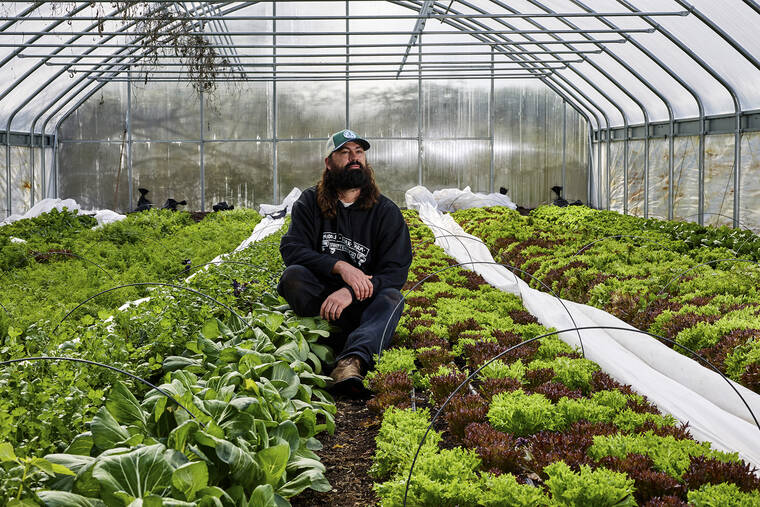
The city’s compost program prevents tons of food waste from being buried in a landfill, where it would produce methane, a greenhouse gas. Local farmers like Morgan Boehm, owner of Middle Fork Farm, rely on that compost. He bought about 50 trailer loads of the rich organic material last year, for $55 each, and said it reduced the weeds at his farm by 90%.
“Just about every farmer that I know of uses it,” said Boehm, who sells peppers, bok choy, arugula and buttercrunch lettuce at a farmers market downtown. “We wouldn’t be where we’re at without it.”
Last year, Fayetteville adopted an ambitious climate plan that won special recognition for including nature-based solutions such as protecting wetlands and forests. It also pledged to improve natural habitats to mitigate flooding and reduce the “heat island effect,” in which cities are warmer than surrounding countryside because of the way pavement and buildings absorb heat.
The plan restated a goal it made in 2018 of reaching 100% clean energy citywide by 2050 and set an interim emissions-reduction target for 2030, an aim that other cities are increasingly shying away from, according to ICLEI — Local Governments for Sustainability USA, an advocacy group.
Eric Fuselier, an environmental scientist hired by the city to design part of the plan, said it also focused on improving ecosystems to better store carbon dioxide emissions, the main driver of climate change.
“Implementation is the most difficult part,” said Teresa Turk, a Fayetteville City Council member and retired federal research fisheries scientist. “Because people can always put this plan on the shelf.”
There are other challenges. Fayetteville has an affordable-housing crunch and is under intense development pressure, driven by both a population that more than doubled in 30 years to surpass 100,000 residents and the expansion of the University of Arkansas. The city also had to put two $20 million climate resilience projects on hold after the Trump administration cut federal grants.
© 2025 The New York Times Company



Get the Latest News
Most Popular
