Mount Everest just recorded some of its most intense snowfall ever
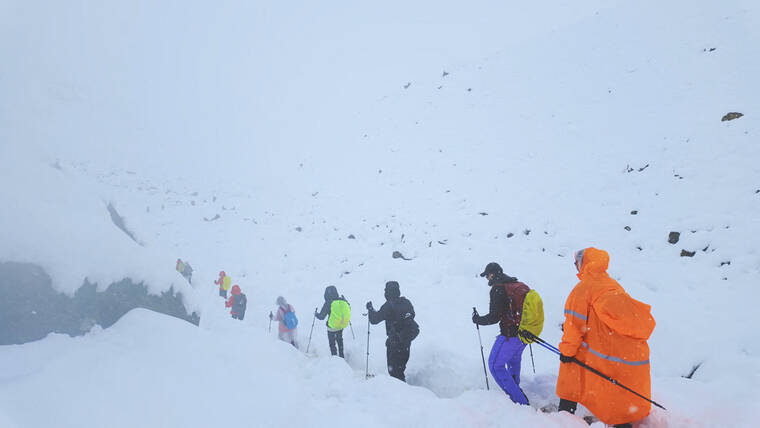
The storm that came spinning out of the Bay of Bengal in the north of the Indian Ocean last weekend was already notable. It pounded the Himalayas — the tallest mountains in the world — and unleashed a torrent of snow that closed roads, buried tents and stranded hundreds of people on Mount Everest.
Now, data from a weather station at an Everest base camp suggests that the rate at which the snow fell during part of the storm may have broken records or, at the very least, was one of the most significant ever recorded.
ADVERTISING
Baker Perry, an expert in high mountain extremes and a professor at the University of Nevada, Reno, called one measurement of the snow that fell “off the charts.”
“No wonder tents were collapsing,” he said.
The record at stake
It wasn’t that long ago that a team of ambitious meteorologists trekked to Mount Everest, not to summit the mountain but to install weather stations at the highest points on Earth. They wanted to better understand the atmosphere and how it affects the water that is stored in the world’s highest mountain chains. The weather stations transmit real-time information about temperature, humidity and precipitation from five locations around the mountain.
Three of the stations transmit information in real time. Two others are offline, including one — the highest weather station in the world — near Everest’s summit. The other, down the mountain at a place called South Col, has data about last weekend’s snowstorm that Perry is eager to collect in person.
Based on what he had seen so far, though, Perry called last weekend’s storm “far and away the biggest” he had observed since he helped install the stations in 2019.
It all has to do with what meteorologists call “water equivalent precipitation,” or the amount of water that is left when a pile of snow is melted.
Water equivalent measurements are especially useful in comparing places that experience intense periods of precipitation, as with lake-effect snow around the Great Lakes or atmospheric rivers in the Pacific Northwest. It’s a scientific way to answer the question of how much rain or snow actually fell, and is often measured in 12- and 24-hour increments.
One of the highest water equivalent measurements ever recorded occurred in 1921 during a snowstorm in Silver Lake, Colorado, when 142 millimeters (about 5.6 inches) of precipitation fell as snow over 27 1/2 hours. That amount has stood as the U.S. record and, though it is disputed, is considered by some to be a world record for snowfall.
On Everest, the highest measurements recorded before this storm were 38 millimeters in a 24-hour period in July 2021 and just over 26 millimeters in a 12-hour period in October that same year.
On Saturday, Perry said, the Everest base camp reported 122 millimeters in 24 hours, 92 millimeters of which came in just 12 hours. Both are more than three times as high as the totals from the 2021 storms.
This week, Perry has been feverishly checking with other scientists across the world to compare data. For now, he said, “I am certainly not comfortable claiming that this is a world record, but I can say that the 12-hour and 24-hour liquid equivalent totals are amongst the highest ever recorded.”
The scientific debate
As the storm swept into the region, it brought along with it water vapor from the Bay of Bengal, said Jay Cordeira, an assistant director for precipitation science at the Center for Western Weather and Water Extremes. He compared it with what happened last year when Hurricane Helene’s circulation passed from the Gulf of Mexico through the Southern Appalachians: The mountains caused the clouds to be squeezed and wrung dry, creating flooding as all that rain fell to the ground. Because of the higher elevation of the Himalayas, the precipitation fell as snow.
There’s disagreement over how significant the snowfall was.
Dinkar Kayastha, with the Nepal Department of Hydrology and Meteorology, said it was “part of the regular monsoon process and not considered unusual or extreme.” The region’s annual monsoon season is caused by the changing of winds and frequently features heavy rainfall.
But Arbindra Khadka, an expert in meteorology at Tribhuvan University in Nepal, said the “large-scale continuous precipitation and snowfall” set this storm apart, as did the amount of snow that fell over such a short period of time on Everest. He called it “a rare event in October,” the kind of snowstorm that happens only every 25 to 50 years.
This article originally appeared in The New York Times.
© 2025 The New York Times Company