Fired CDC director describes clashes with Kennedy and turmoil at agency
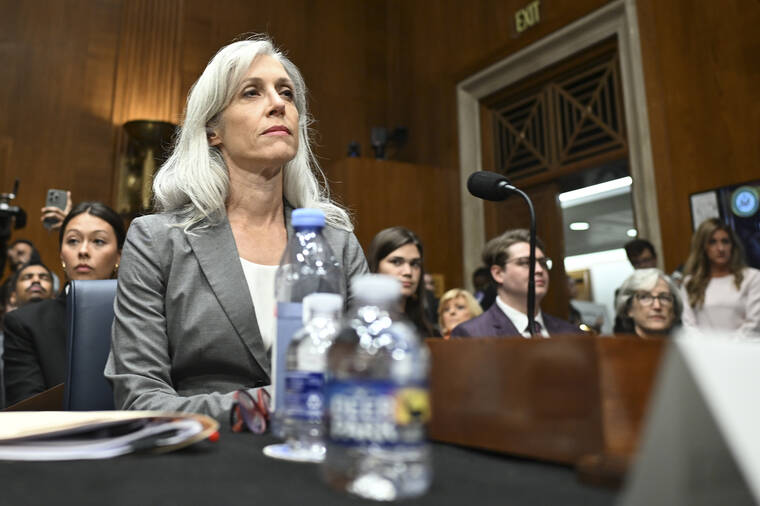
WASHINGTON — The former director of the Centers for Disease Control and Prevention told a Senate panel Wednesday that Health Secretary Robert F. Kennedy Jr., called CDC employees “corrupt” and accused them of “killing children” during a tense private meeting with her the week before she was fired.
In a sometimes contentious hearing before the Senate health committee, Dr. Susan Monarez told senators she was fired “for holding the line on scientific integrity.” She said she refused Kennedy’s demands to fire top CDC scientists and to sign off on vaccine recommendations issued by his handpicked advisory panel without seeing the data or science underlying them.
ADVERTISING
Monarez painted a picture of the health secretary as a man wedded to his own ideology and uninterested in government scientists. She said Kennedy tried to prevent her from talking to career CDC experts or communicating with senators, and insisted that decisions be routed through political appointees.
“If you’re willing to sign off on decisions that are not made with the best available data and evidence, it does put at risk our children,” Monarez said. “It puts at risk others who need these vaccines, and it takes us into a very dangerous place in public health.”
Wednesday’s hearing exposed tumult at the nation’s public health agency, which long has been a target of Kennedy. At a recent Senate hearing, he defended his shake-up of the agency, saying: “We are the sickest country in the world. That’s why we have to fire people at CDC. They did not do their job. This was their job to keep us healthy.”
Before the hearing, a spokesperson for Kennedy, Andrew Nixon, disputed her account as laid out in her prepared remarks. He said Monarez was fired because she “acted maliciously to undermine the president’s agenda” and that the health secretary “is focused on restoring public trust in the CDC by ensuring transparency, accountability and diverse scientific input.”
Monarez and another former CDC official, Dr. Debra Houry, described in vivid detail some of the turmoil inside the CDC, which has endured a wave of layoffs, a shooting at its headquarters in Atlanta that killed a police officer, and the resignations of some of its top scientific officials. Houry, the agency’s former chief medical officer, who served at the CDC under four presidential administrations, said Kennedy needed to resign.
Houry told senators that CDC vaccine experts were so rattled by the shooting that they are afraid to put their names on their own scientific papers. Monarez said Kennedy did not call her to express condolences; the next time they spoke was three days after the shooting, when he toured CDC headquarters.
The three-hour session came as the vaccine panel, the Advisory Committee on Immunization Practices, is preparing to meet in Atlanta on Thursday and Friday. The panel’s recommendations usually influence which vaccines insurance companies cover. But in what amounted to a preemptive rebuke, an insurance trade group said this week that coverage would not change even if the panel’s recommendations did. The recommendations also affect which shots children can get without cost through the federal Vaccines for Children Program.
The panel, known as ACIP, is typically composed of a broad range of experts in vaccination. Kennedy fired all 17 members this spring and replaced them with his own lineup of advisers, some of whom share his skepticism about vaccines. Monarez, who was awaiting confirmation at the time, said she was not consulted on that decision.
Monarez testified that Kennedy told her the childhood vaccine schedule would change in September and claimed that “there was no science or evidence” behind the existing recommendations. Critics, including Kennedy, have called for the CDC to abandon its long-standing recommendation that infants receive hepatitis B vaccination at birth.
“I’m very nervous about it,” Monarez said about the meeting. “There is real risk that recommendations could be made restricting access to vaccines for children and others in need without rigorous scientific review.”
The hearing was convened by Sen. Bill Cassidy, R-La., chair of the Senate health committee, who cast a crucial vote that cleared the way for Kennedy’s confirmation. A physician, he is an ardent proponent of vaccines.
But Cassidy is in political peril at home, facing a tough primary challenge from the right. In the seven months since Kennedy has been in office, Cassidy has walked a fine line, alternating between praise and criticism of the health secretary, though his criticisms have become more aggressive of late.
Asked after the hearing if Americans should have confidence in the decision of the vaccine advisory panel if it changes the childhood vaccination schedule, he said they should not. The senator, a liver specialist, told reporters that the hepatitis B vaccine given to infants immediately after birth has brought the number of children with the disease each year down from 20,000 cases to around 20.
But two other Republican doctors on the committee — Sen. Rand Paul of Kentucky and Sen. Roger Marshall of Kansas — expressed skepticism about the CDC’s vaccination schedule and whether all the recommendations were backed by rigorous science.
“The biggest difference in philosophy that I see, is that I think the CDC is the cause of vaccine hesitancy,” Marshall told Monarez. “You are the problem.”
Wednesday’s hearing was the first time during Kennedy’s tumultuous tenure that health officials who have worked under him have come to Capitol Hill to give a public assessment of his leadership. It also put on display the topsy-turvy nature of the politics of public health.
Some of the Republicans who voted to confirm Monarez accused her of lying. Three — Sens. Markwayne Mullin of Oklahoma, Jim Banks of Indiana and Ashley Moody of Florida — berated her for hiring Mark Zaid, a lawyer who has spoken out against President Donald Trump, as her attorney.
Democrats, all of whom voted against her confirmation, treated Monarez like a hero. One, Sen. Tim Kaine, D-Va., publicly apologized.
“I had concern about your backbone, and I was wrong,” Kaine said. “And I apologize to you for being wrong.”
At the same time, there was a question of congressional power. Monarez was the first Senate-confirmed CDC director; Congress passed a law requiring Senate confirmation in the wake of the coronavirus pandemic. Cassidy wondered aloud what good it did for the Senate to confirm a nominee, only to see her fired 29 days later.
Sen. Bernie Sanders, I-Vt., the ranking member of the committee, was more pointed.
“How did Dr. Monarez go from being a public health expert with unimpeachable scientific credentials who had the full confidence of Secretary Kennedy into being a liar and untrustworthy in less than a month?” he asked, adding: “I think the answer is fairly obvious. Dr. Monarez was fired because she refused to act as a rubber stamp to implement Secretary Kennedy’s dangerous agenda.”
While Kennedy has promised “radical transparency,” both Monarez and Houry told senators that decisions on vaccine policy were made without public discussion of the science. Houry said she learned of the government’s decision not to recommend the COVID-19 vaccine for healthy children and pregnant women on social media after Kennedy posted on X.
She said she had asked for a written memorandum and data because she “couldn’t implement guidance based on a tweet.” But the data, she said, was not forthcoming. She also recounted having to respond quickly to Kennedy’s false statements disparaging vaccines.
“He said things like, ‘vaccines had fetal parts,’ and I had to send a note to our leadership team to correct that misinformation,” Houry said. Some vaccines were developed with cell lines derived decades ago from aborted fetuses, but vaccines do not contain fetal parts.
Both Monarez and Houry said they feared for the future of public health. Both said they feared the United States was not prepared for a future pandemic.
Monarez warned that if vaccines became harder to get, preventable diseases would surge back, and that American children would be harmed. The United States has already had a measles resurgence this year, and whooping cough cases are higher now than they were before the COVID pandemic.
Monarez repeatedly asserted that she was open to making changes in vaccine recommendations, but only based on data and evidence. Kennedy, she said, had another view.
She testified that on Aug. 25, Kennedy directed her to commit in advance to approving every recommendation made by the vaccine advisory panel, “without data or science.” He also directed her, she said, to dismiss career officials responsible for vaccine policy without cause. If she was unwilling to do so, she said, Kennedy told her that she should resign.
“I could have stayed silent, agreed to the demands, and no one would have known,” Monarez said. “What the public would have seen were scientists dismissed without cause and vaccine protections quietly eroded, all under the authority of a Senate-confirmed director with unimpeachable credentials. I could have kept the office, the title, but I would have lost the one thing that cannot be replaced: my integrity.”
This article originally appeared in The New York Times.
© 2025 The New York Times Company