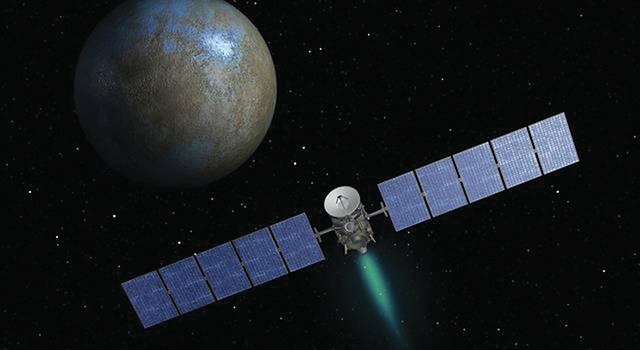
NASA’s Dawn spacecraft is on a mission to study Vesta and Ceres, the two largest members of the asteroid belt. These diverse asteroids offer crucial scientific clues into the birth of our solar system some 4.6 billion years ago.
NASA’s Dawn spacecraft is on a mission to study Vesta and Ceres, the two largest members of the asteroid belt. These diverse asteroids offer crucial scientific clues into the birth of our solar system some 4.6 billion years ago.
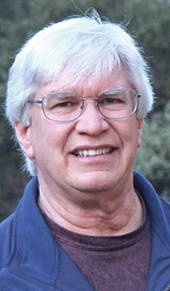
Learn more about this epic quest for knowledge at 7 p.m. Jan. 19 during ‘Imiloa Astronomy Center’s next Maunakea Skies talk with Schelte “Bobby” Bus, deputy director at the NASA Infrared Telescope Facility on Maunakea.
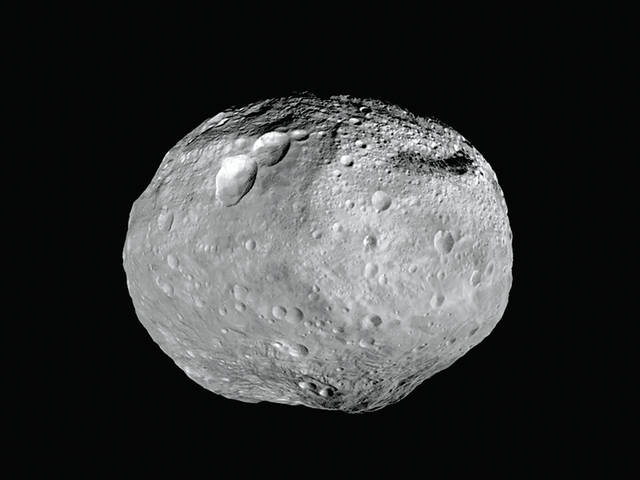
Although the massive asteroids Vesta and Ceres hold similarities that help us understand the formation of our solar system, they have many differences in their geological makeup. Vesta has a rocky body, while Ceres is thought to contain large amounts of water and has an icy surface.
Vesta’s south pole contains a massive crater measuring 285 miles across and 8 miles deep — caused by a giant collision that gouged out 1 percent of its volume. This collision blasted out more than a half million cubic miles of rock into outer space. Scientist think this single collision is the cause for about 5 percent of all meteorites discovered on Earth.
After more than 10 years of exploration, the Dawn Mission is nearing its end. The amazing images and measurements that have returned from this mission are leading scientists to a better understanding of what we see today in our solar system. Bus will share highlights from the Dawn Mission, paired with a discussion on the ground-based observations, like those made at NASA IRTF on Maunakea — which have helped enhance the scientific return from this exciting mission of discovery.
Bus received his doctorate in planetary science in 1999 from the Massachusetts Institute of Technology. In 2000, he moved to Hilo to accept a position with the University of Hawaii’s Institute for Astronomy as a staff astronomer for NASA IRTF. He became deputy director of NASA IRTF in 2017. His research focuses on the physical properties of asteroids and how processes such as collisions alter the asteroid belt, helping to feed material such as meteoroids and near-Earth asteroids into near-Earth space.
Hosted by planetarium technician Emily Peavy, ‘Imiloa’s monthly Maunakea Skies program includes observational highlights of the current night sky over Hawaii, with the audience able to view prominent constellations and stars visible during this time of year.
Maunakea Skies planetarium presentations are on the third Friday of each month. General admission tickets are $10 or $8 for ‘Imiloa members. Prepurchase tickets at ‘Imiloa’s front desk or by phone at 932-8901.

Subscribe today for unlimited access.
Already a subscriber?
Login
Not ready to subscribe?
Register for limited access.
If you have a print subscription but require digital access,
activate your account.