No Kevin Durant, no answer: Lakers take Game 1 from Rockets
Without their two most prolific 3-point shooters during the regular season, the Los Angeles Lakers had another option at hand.
Luke Kennard, acquired in early February from the Atlanta Hawks, was 5-for-5 on 3-pointers and finished with 27 points — more than he had in any regular-season game this season — in the Lakers’ 107-98 win over the Houston Rockets in Game 1 of their series.
ADVERTISING
The Rockets’ last lead came just 1:01 into the game, when Amen Thompson converted on a layup to make it 4-2. Kennard buried his first shot on the next Lakers possession, and the Rockets were reduced to pushing the boulder uphill the rest of the way.
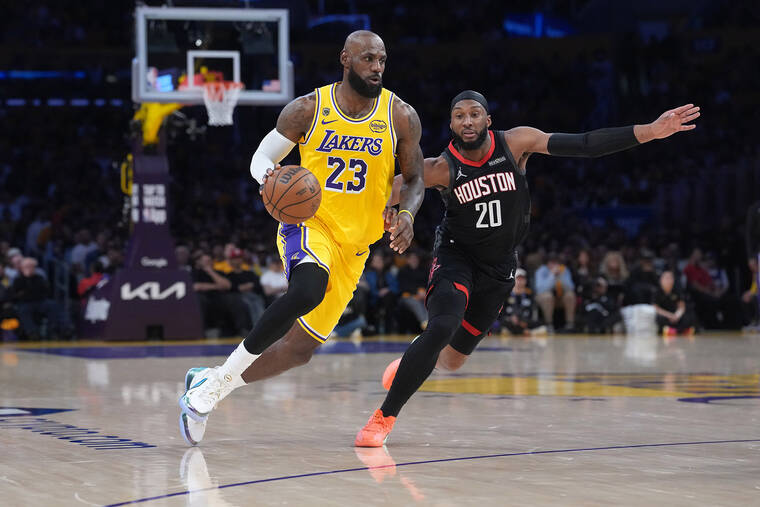
LeBron James scored 19 points and had 13 assists — 10 in the first half.
The Rockets were without Kevin Durant, who suffered a knee injury in practice Wednesday and was ruled out shortly before tipoff. The team hopes he will be able to play in Tuesday’s Game 2.
The Lakers, meanwhile, were without Luka Doncic and Austin Reaves, both of whom last played April 2.
Here are our immediate takeaways from Game 1 in Los Angeles:
The question in coaches’ offices across the NBA for the better part of two decades when facing LeBron James has always been the same: how does he hurt you most — as a scorer or a passer?
That conversation faded over the past two seasons as the Lakers shifted more offensive responsibility to Reaves and Doncic. But with James back atop the scouting report to open the playoffs, you have to believe Houston would have preferred he look to score. Instead, he dissected them as a passer.
James’ 10 first-half assists — eight in the first quarter — set the tone for a balanced Lakers attack, one that consistently generated clean looks off the attention he drew. He finished with 19 points, but it was the 13 assists that did the real damage.
With Kevin Durant’s surprising absence in Game 1, it was no secret that a lot would fall on Sengun’s shoulders to keep the Rockets’ offense afloat.
Houston’s All-Star center already does a lot for his team as an offensive hub and a high-volume post scorer. But without Durant, it was time for him to show he can step up and play like a superstar in a game his team needed him to be the tone-setter.
Instead, he was mostly absent on Saturday night. In the Rockets’ 107-98 loss to LA, Sengun had 19 points, eight rebounds and six assists, which doesn’t look terrible on paper. But he shot 3 of 14 from the field after the first quarter and he couldn’t do enough to take advantage of the Lakers’ center combo of Deandre Ayton and Jaxson Hayes.
Houston’s horrid spacing and uneven point guard play from Reed Sheppard — who shot 6-of-20 from the field himself — certainly didn’t help. But Sengun has to be better than this. Even if Durant plays, the Rockets can’t afford to have their second-best player be such a non-factor. The Rockets depend on their top guys to create offense more than most teams, and Sengun has proven throughout his career that he’s capable of being dominant with his passing vision and his scoring around the basket.
As much as the Rockets need Durant back in Game 2, they need the real Sengun back just as much.
There’s a scene in Moneyball where Brad Pitt, as Billy Beane, gathers his scouts and lays it out plainly: you don’t replace stars with one player — you replace them in the aggregate.
That became the Lakers’ reality after the late-season injuries to Austin Reaves and Luka Doncic. But in Saturday’s Game 1, one player carried more than his share.
Luke Kennard wasn’t acquired to handle this kind of load — not this often, not in these moments — even if coaches insist they knew he could. Yet with the Lakers’ backcourt depleted, Kennard stepped into a primary ballhandling role and thrived against Houston’s pressure.
He handled Amen Thompson as well as anyone could have hoped, finishing 9 for 13 from the field and knocking down three massive 3-pointers in the fourth quarter.
This article originally appeared in The Athletic.
© 2026 The New York Times Company