
The 4 Americans killed in the Iran war who have been identified
On Saturday morning, the United States and Israel launched coordinated strikes on Iran. By Sunday, the world’s attention was on Iran’s supreme leader, Ayatollah Ali Khamenei, who was killed in the attacks.
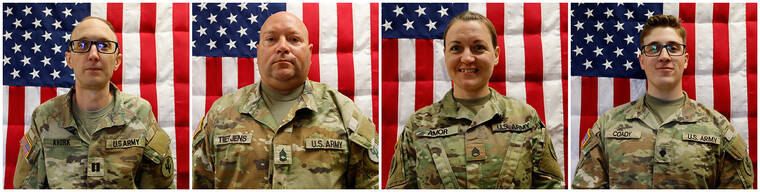
But six U.S. service members were also killed. And on Tuesday evening, federal officials identified four of them, saying they were all Army Reserve officers who died during an unmanned aircraft system attack in Port Shuaiba, Kuwait. The attack is under investigation.
ADVERTISING
The four deceased are Capt. Cody A. Khork and Sgts. Nicole M. Amor, Declan J. Coady and Noah L. Tietjens. Family and friends of the Army Reserve officers were grappling with their loved ones’ deaths Tuesday. The two other service members killed in the attacks have not yet been identified.
“We honor our fallen Heroes, who served fearlessly and selflessly in defense of our nation,” Lt. Gen. Robert Harter, the chief of Army Reserve and the commanding general of U.S. Army Reserve Command, said in a statement. “Their sacrifice, and the sacrifices of their families, will never be forgotten.”
Noah L. Tietjens, 42
Raised in a military family, Sgt. 1st Class Noah L. Tietjens joined the Army in the early 2000s and had completed at least four tours in countries including Kuwait and Iraq.
He had proved himself to be a “great leader,” his twin brother, Nicholas, said, and was three months away from wrapping up his deployment in Kuwait. Upon his return, he had hoped to open a martial arts studio in his home in Bellevue, Nebraska, south of Omaha.
“He just wanted to get there, and get it over with, and get back,” his brother said.
Tietjens left behind a wife, Shelly, and a teenage son, Dylan, whom he had enrolled in martial arts school eight years ago. Julius Melegrito, owner of Martial Arts International in Bellevue, said Tietjens was calm, confident and soft-spoken, traits he said made him fit to teach and lead.
During the COVID-19 pandemic, Tietjens was invaluable in helping the martial arts studio handle social distancing, said Melegrito’s wife, Faith.
“He has this commanding presence and friendly aura around him,” Melegrito said. “Since then, whenever we would have events or he would be at the school, I would always feel more calm when he’s around, because I knew he would look at what’s needed and he would take care of it.”
Jonn Coleman, a mentee of Tietjens’ at the 443rd Transportation Co. out of Elkhorn, Nebraska, said he owed much of his own military career to Tietjens’ coaching. Having been belittled for years, he said, he remembered feeling that Tietjens was “a breath of fresh air” in the military.
“He had a great way of inspiring others and leading by helping them instead of just complaining,” Coleman said. “His positive attitude is something a lot of other people should do.”
Sen. Deb Fischer, R-Neb., extended condolences to the Tietjens family in a statement Tuesday. “His courage and sacrifice in service to our nation will be forever honored,” she said.
Cody A. Khork, 35
The Department of Defense said in a statement that Capt. Cody A. Khork was a resident of Lakeland, Florida, and enlisted as a 13P (multiple launch rocket system/fire direction specialist) in the National Guard in 2009.
The statement said he commissioned as a military police officer in the Army Reserve in 2014. He deployed to Saudi Arabia in 2018, Guantánamo Bay, Cuba, in 2021, and Poland in 2024.
Nicole M. Amor, 39
The Department of Defense said in a statement that Sgt. 1st Class Nicole M. Amor was a resident of White Bear Lake, Minnesota, and enlisted in the National Guard as a 92A (automated logistics specialist) in 2005. She transferred to the Army Reserve in 2006 and deployed to Kuwait and Iraq in 2019.
Sgt. Declan J. Coady, 20
The Department of Defense said in a statement that Sgt. Declan J. Coady (posthumously promoted from specialist), was a resident of Des Moines, Iowa, and enlisted in the Army Reserve in 2023 as a 25B (Army information technology specialist).
This article originally appeared in The New York Times.
© 2026 The New York Times Company



Get the Latest News
Most Popular
