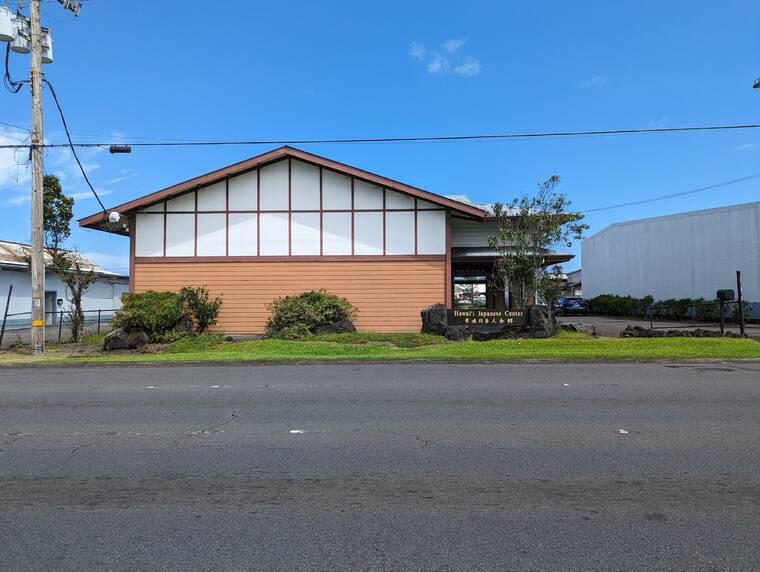
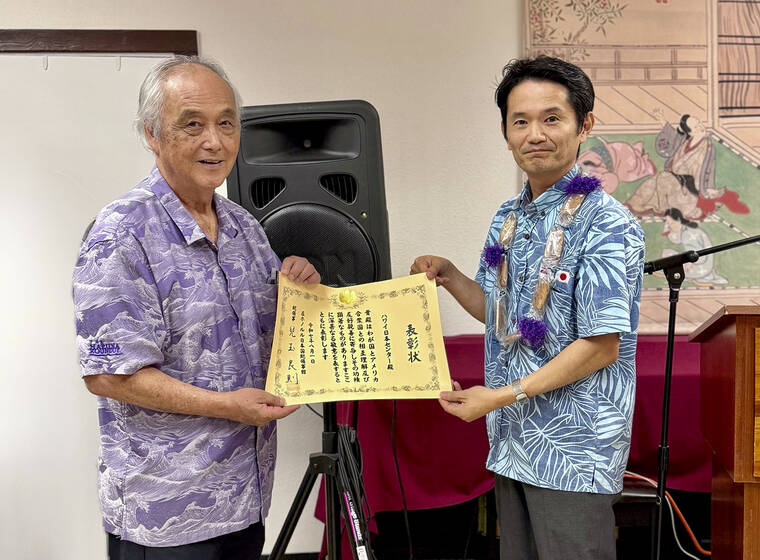
The Hawaii Japanese Center in Hilo received a commendation from the Consulate General of Japan in Honolulu in August for “contributing to the deepening of mutual understanding and friendship between Japan and the United States.”
The cultural center and museum on Kanoelehua Avenue is home to countless documents and artifacts of Japanese-American history in Hawaii, many donated by locals as they clean out historic homes. Those donations and the dedication of volunteers helped the center, established in 2002, survive and improve during the pandemic.
Arnold Hiura, the center’s president and executive director, said he and his team were busy preparing a display about artistic representations of monsters and the supernatural known as “yokai” when he was presented the commendation by Deputy Consulate General Hiroki Haruta on Aug. 1.
“It was a complete surprise,” Hiura said. “There are so many worthy organizations that to be selected is quite an honor. It’s a tribute to our volunteers.”
The “Yokai Parade” exhibit at HJC throughout August was a traveling show by the Japan Foundation, an organization that presents Japanese culture worldwide through touring exhibits. Hilo was the only Hawaii stop of four recent Japan Foundation exhibits with traditional arts and crafts, dolls, manga and anime, and yokai, Hiura said.
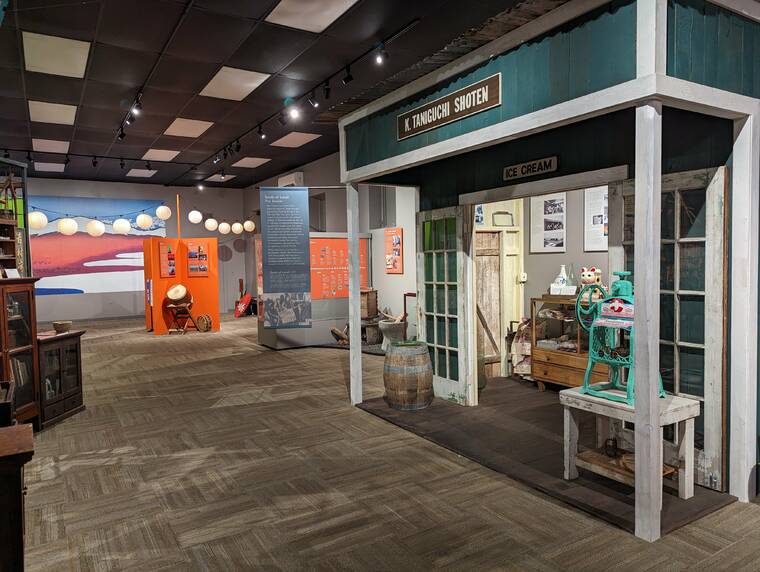
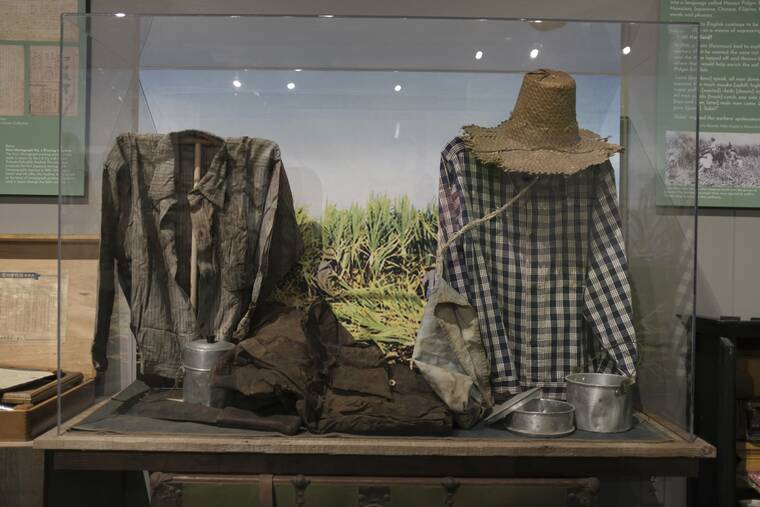
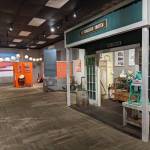
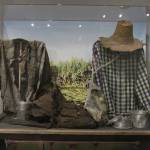
Past the free-entry gift shop in the front room lies the permanent Seeds of Local exhibit, which is $10 for general admission, $5 for seniors and students, and free for Hawaii Japanese Center members and children under the age of 5. The arrival of issei, first-generation Japanese immigrants, in 1880s Hawaii to work on sugar plantations is displayed with items like antique farm equipment and palaka shirts.
The display includes early food preparation tools like metal rice cracker presses, stone bowls for mixing mochi and creating tofu, and wood and wire antique presses to create a variety of noodles. There’s a traditional two-tiered lunch pail representing the plantation lunchtimes where Japanese, Chinese, Filipino, Korean and Hawaiian workers shared various ethnic foods as they conversed in the blend of languages that became pidgin.
“One of the special strengths we have on Big Island is that we still have these old homes surviving up and down the coast, whether you go down towards Ka‘u or mauka to Kohala, Honokaa,” Hiura said, explaining that when families clean the homes to rent or sell “out comes all these things from grandma’s time.”
The exhibit then chronicles “nisei,” Hawaii-born second-generation Japanese-Americans, with Olympians like weightlifting Kona native Harold Sakata — who became the professional wrestler Tosh Togo and portrayed James Bond villain Oddjob in “Goldfinger” — and the Japanese-American affinity for baseball. A 1933 photo of Babe Ruth posed with the Waiakea Pirates at Hoolulu Stadium is displayed with gear donated by a baseball history organization. That display that hit home with a visitor to the center.
“One visitor who was born and raised in Hilo and is now retired on Oahu (saw the Babe Ruth picture, pointed to a player) and said, ‘That’s my dad,’” Hiura recalled, adding that the visitor also recognized the displayed vintage baseball glove as his father’s.
“He came back with his grandson specifically to show him his great-grandpa’s picture.”
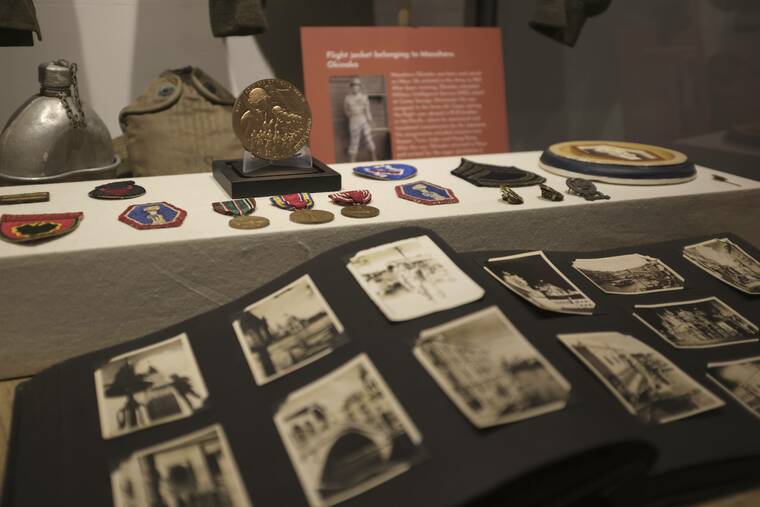
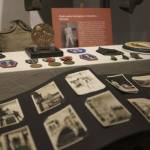
Other notable artifacts in the exhibit include two ornate hanging lanterns that Hiura said are the only surviving pieces of a burned-down Buddhist temple from his hometown of Papaikou, a roll of vintage Mountain View Theater movie tickets displaying a cost of 22 cents admission, and a vintage ice shaving machine. Medals, clothing, and photo albums were all donated by Japanese-Americans in Hawaii to preserve their people’s history.
“A lot of times, people want to donate what they call ‘nice things.’ They say, ‘I have grandma’s kimono, I have a really nice Japanese doll’…and I say, ‘That’s very nice, thank you very much, but what is that rusty old wooden thing sitting in the corner?’” Hiura said, with a laugh, about some of the most unique artifacts.
“The things I get most excited about are original … documents — family documents, passports, labor contracts. Things that we talk about, things you see in history books, but are actually quite rare to have examples of them,” he said.
The center also has conference rooms where visiting scholars discuss artifacts and examine the wealth of books and papers in the center’s library, including 25 file boxes of work by noted Japanese-American journalist Jack Yoshitami Tasaka, which Hiura said has drawn people from as far as Scotland.
The Seeds of Local exhibit was set up during the pandemic, which is also when volunteers began digitizing the priceless books and documents to eventually make them available online, Hiura said. Elder local Japanese-Americans are also being interviewed on-camera in a studio at HJC to preserve the stories of issei, nisei, and sansei, the third-generation Japanese-Americans in Hawaii, of which Hiura, 74, considers himself.
“Japanese have emigrated all throughout the world … but every ethnic community sets down roots and creates a cultural blend with the host culture,” Hiura said. “Every place is different, and Hawaii is very unique in that respect, as well.”
The Hawaii Japanese Center is open from 11 a.m. to 3 p.m. Wednesday through Saturday. To request use of the conference rooms or arrange guided tours, call (808) 934-9611 or email info@hawaiijapanesecenter.com.
Email Kyveli Diener at kdiener@hawaiitribune-herald.com.