Trump rejects sending US. troops to Ukraine as part of a peace deal
President Donald Trump said Tuesday that no American ground troops would be sent to Ukraine as part of a potential peace agreement with Russia, a day after a round of intense diplomacy in Washington yielded few details on how to stop the war and prevent future Russian aggression.
U.S. and European officials have raised the possibility of sending Western troops into Ukraine as postwar peacekeepers, and Trump said the United States could potentially back the forces with air support. But he said that the United States would not provide “boots on the ground.”
ADVERTISING
“You have my assurance, and I’m president,” he said on Fox News. Russia has flatly rejected the idea of an international force on its borders.
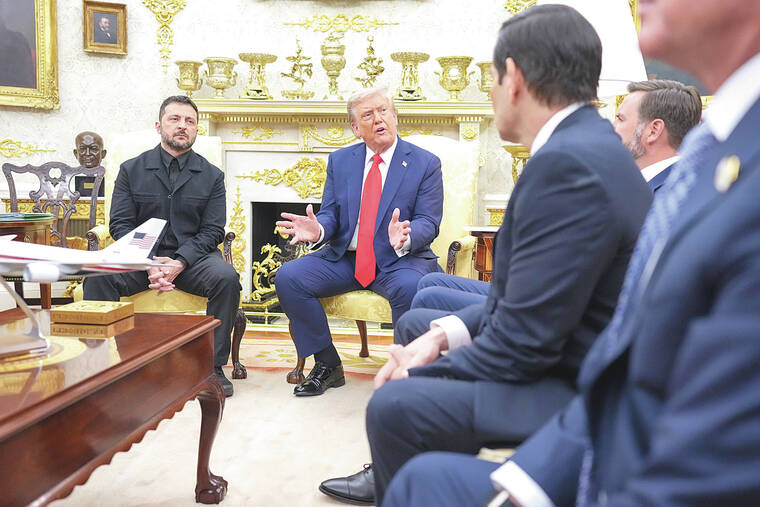
Trump’s comments came a day after seven European officials — including the leaders of Britain, France, Italy, Germany and NATO — met with Trump and President Volodymyr Zelenskyy of Ukraine at the White House in an effort to forge an agreement that could end the war. And skepticism grew Tuesday among some Europeans as to whether bilateral talks would take shape.
Their meetings — held after Trump welcomed President Vladimir Putin of Russia to Alaska last week — produced smiles and expressions of solidarity with Ukraine but few tangible signs of progress 3 1/2 years after Russia launched its full-scale invasion.
On several critical issues — including postwar security guarantees for Ukraine, potential territorial concessions and the need for an immediate ceasefire — Zelenskyy and Putin continue to express strong disagreements.
Overnight, Russia launched hundreds of drones and missiles at Ukraine, causing injuries and damage to infrastructure and energy facilities, Ukrainian officials said, a day after at least 14 people were killed in Russian strikes.
Trump and his special envoy, Steve Witkoff, have suggested that Putin would agree to European troops in Ukraine as part of a postwar security arrangement to dissuade future Russian attacks, so long as Ukraine does not join NATO and the ground forces aren’t organized by the Western military alliance. Through its foreign ministry, Russia on Monday again denounced the idea of international troops patrolling Ukraine, calling it “demonstrably unviable.”
Russia has insisted on territorial concessions that Ukraine has rejected. Ukraine has insisted on a ceasefire that Russia has opposed.
And while Zelenskyy said Ukraine would purchase $90 billion in American weapons through Europe as part of its security guarantees, he left the White House on Monday without a formal agreement toward peace.
On Tuesday, Karoline Leavitt, the White House press secretary, said that Putin had agreed to meet with Zelenskyy for bilateral talks that Trump believes are a critical next step in the push for a peace deal. After the leaders of Russia and Ukraine meet, Trump has said he was hoping to set up a trilateral meeting with Putin and Zelenskyy.
But Russia’s foreign minister, Sergey V. Lavrov, played down the prospect of direct talks between Zelenskyy and Putin.
In an interview on state-run television, Lavrov said that while Russia was not opposed to a meeting between Zelenskyy and Putin in principle, “any contacts involving top officials should be prepared very carefully.”
Lavrov also referred to Zelenskyy dismissively as “this character” and “this man,” and suggested that the Ukrainian president must repeal laws that the Kremlin believes curtail the rights of Russian speakers in the country before entering into direct negotiations with Putin.
Lavrov’s comments suggested that Moscow may be treading a fine line to make sure it doesn’t offend Trump or undermine his efforts to bring the war to an end while offering at least a semblance of progress.
Yuri V. Ushakov, the Kremlin’s foreign policy aide, said after Monday’s White House talks that Trump and Putin had a call in which they discussed “exploring opportunities to bring more senior officials from both Ukraine and Russia into these direct talks.” He made no mention of whether Putin would participate.
Ushakov’s comments, published by the Kremlin, suggested that Russia was offering talks with senior officials as the next step in the peace process.
Beyond the lack of clarity around Putin’s potential involvement in the next round of talks, there has been no agreement between Russia and Ukraine on the idea of a Western military force moving into a postwar Ukraine.
Speaking Tuesday in an interview on “Fox and Friends,” Trump said European nations, including Britain and France, were willing to deploy forces to help Ukraine keep the peace.
“They want to have boots on the ground,” Trump said. “I don’t think it’s going to be a problem, to be honest with you.”
Prime Minister Keir Starmer of Britain said security guarantees for Ukraine would include an international force stationed there after a ceasefire or peace agreement. That contingent could be as small as a few hundred observer troops, a tripwire force of thousands or a peacekeeping force in the tens of thousands.
Ukrainian leaders have welcomed the idea of a European force.
“Our desire for NATO membership remains unchanged, but as an interim solution, we will be satisfied with any truly effective security guarantees,” Yehor Chernev, the deputy chair of the Ukrainian parliament’s defense and intelligence committee, said in a text message.
But some security experts questioned if Europe could deploy a viable security force to protect Ukraine, without robust U.S. military support.
© 2025 The New York Times Company