Trump takes control of DC police, citing ‘bloodthirsty criminals.’ But crime is down
WASHINGTON — President Donald Trump on Monday took federal control of the police force in the nation’s capital for 30 days and mobilized 800 National Guard troops to fight crime in a city that he claimed was overrun with “bloodthirsty criminals,” even though crime numbers in Washington are falling.
During a 78-minute news conference, during which he was flanked by several members of his Cabinet, Trump took the lectern in the White House briefing room and said he also intended to clear out the capital’s homeless population, without saying how officials would do it, or detailing where those people would go.
ADVERTISING
Armed with papers that showed crime statistics, Trump decried murders in Washington compared with other global cities but ignored the fact that violent crime has fallen recently in the nation’s capital. While the violent crime rate surged in 2023, it fell 35% from that year to 2024, according to the city’s Metropolitan Police Department.
Instead, Trump painted Washington as an urban hellscape, repurposing some of the incendiary language he has used to describe conditions at the southern border. Trump has railed against crime in urban, largely liberal cities for decades, but his announcement Monday was an extraordinary exertion of federal power over an American city. Warning of “caravans of mass youth” rampaging the city streets and relaying stories of children caught in shootings, Trump blamed Democrats for allowing the crime.
“Our capital city has been overtaken by violent gangs and bloodthirsty criminals, roving mobs of wild youth, drugged-out maniacs and homeless people,” Trump said. “And we’re not going to let it happen anymore.”
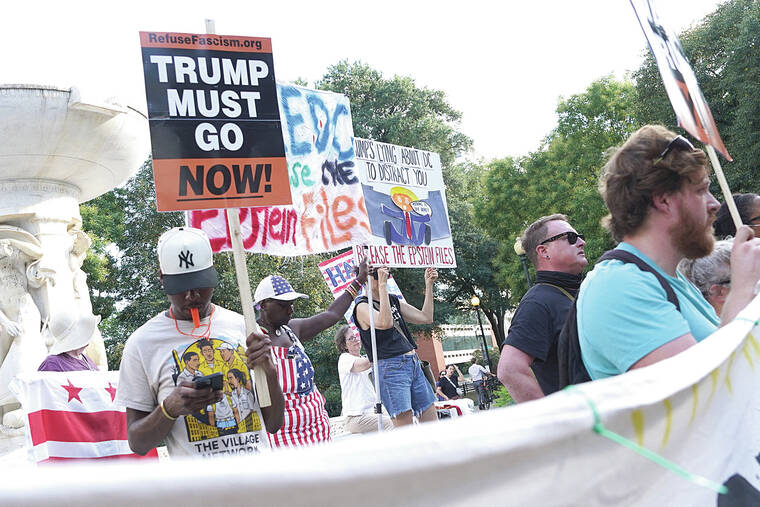
Local officials immediately criticized the president’s actions, and pockets of protesters sprang up around the city shortly after Trump declared a public safety emergency in Washington. Muriel Bowser, the mayor of Washington, said in a news conference Monday afternoon that Trump’s actions were “unsettling and unprecedented,” but not surprising.
“I can’t say that given some of the rhetoric of the past that we are totally surprised,” Bowser said, before adding that the police chief, Pamela A. Smith, would remain in her position. Bowser acknowledged that the law gave Trump the authority to take over the department temporarily. But she disputed the idea that her administration had done little to curb violent crime in Washington.
“There’s nobody here and certainly nobody who works for me who wants to tolerate any level of crime,” said Bowser, a Democrat. “We work every day to stop crime.”
There are practical questions about how Trump’s plans would be implemented. The Trump administration is relying on a provision of the D.C. Home Rule Act, a law passed by Congress in 1973 establishing local control of Washington. The law gives the president the power to temporarily take over the Metropolitan Police Department. A White House official said the takeover would last 30 days, a time limit outlined in the law.
Federal officials were still working out many of the operational details of the president’s plan Monday afternoon, even though small groups of agents had been conducting limited patrols over the weekend.
The effort envisions about 500 federal law enforcement officers, drawn from a host of agencies that operate in Washington, to be used for some version of patrol or support roles of local police, according to two officials who spoke on the condition of anonymity to describe the still-developing plan.
That figure includes roughly 120 FBI agents and about 50 deputy U.S. marshals, as well as agents from the Drug Enforcement Administration and the Bureau of Alcohol, Tobacco, Firearms and Explosives, among other agencies.
Some of those agents will be on foot or car patrol duty, while others may be assigned to be visible in high-crime or high-traffic areas, according to the officials.
One complicating factor of using federal agents for essentially street-based police work is that those agents do not have the same authority as police officers to arrest people for minor criminal offenses, so the current view among Trump administration officials is that if federal agents see someone commit such a crime, they can stop and detain them until a local police officer arrives and makes an arrest.
Trump said Attorney General Pam Bondi would oversee the broad effort. He said that Gadyaces S. Serralta, who was sworn in as the director of the U.S. Marshals Service this month, would oversee the police department alongside Terry Cole, who was sworn in as the head of the Drug Enforcement Administration less than a month ago.
“I hope I don’t have to fire him in two weeks because he’s too soft,” Trump said after calling Serralta up to the briefing room lectern to shake his hand. “If you’re soft, weak and pathetic, like so many people, I will fire you so fast.”
One by one, Trump summoned members of his Cabinet and others to the lectern to discuss how they would carry out his orders. Interior Secretary Doug Burgum said U.S. Park Police officers had been patrolling federal parkland and traffic circles in the city for months, and had removed dozens of encampments of homeless people. And Defense Secretary Pete Hegseth said 800 National Guard officers would be “flowing” into the city over the next week.
Jeanine Pirro, the U.S. attorney for the District of Columbia and a former Fox News personality, delivered a cable-ready monologue against laws in the District that prevent charging minors as adults.
“I see too much violent crime being committed by young punks who think that they can get together and gangs and crews and beat the hell out of you or anyone else,” Pirro said. “We need to go after the D.C. Council and their absurd laws.”
Trump and Pirro both denounced the use of no-cash bail in Chicago and in Washington, where it has been effectively eliminated since 1992. The practice allows some defendants to be released from jail without posting bail that would help ensure their return to court.
As he threatened to get involved with repealing no-cash bail in Chicago, Trump suggested that other cities would soon be subject to federal intervention, thought it is unclear what legal grounds he could use to exert federal control over them.
“I’m going to look at New York in a little while,” Trump said, “and if we need to, we’re going to do the same thing in Chicago, which is a disaster.”
Critics of the administration’s efforts said Trump deserved part of the blame for crime in Washington. Ankit Jain, a shadow senator for the District of Columbia who is the capital’s advocate in Congress in lieu of official senators, said the vacancy crisis in the U.S. attorney’s office, which prosecutes all adult crimes, had contributed to crime in the city. He also said the city is down two judges out of nine on its highest court, the D.C. Court of Appeals.
© 2025 The New York Times Company