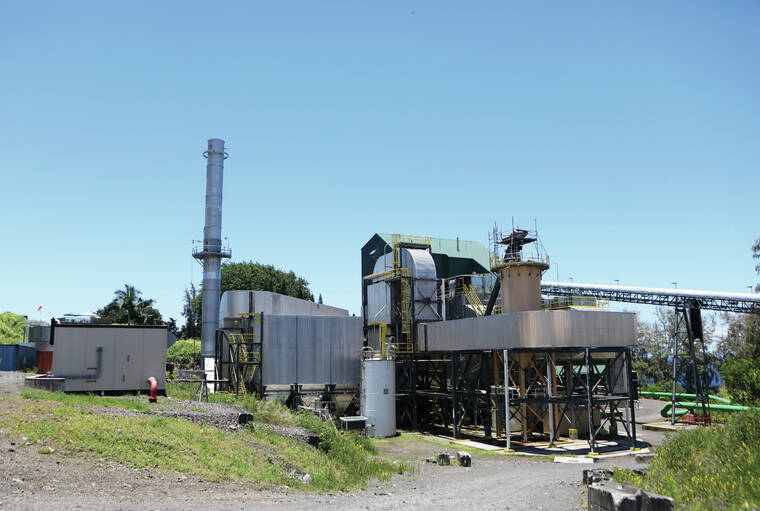
After numerous thwarted attempts to go online, a completed but long-idle bioenergy power plant in Pepeekeo is once again in contract negotiations to generate power and sell it to Hawaiian Electric Co.
A June 3 letter to the state Public Utilities Commission from HECO and Hu Honua Bioenergy LLC — the parent company of the Honua Ola power plant — notified commissioners that HECO has received an offer from Honua Ola “to sell energy and capacity … as a qualified facility under PURPA.”
PURPA, the Public Utility Regulatory Policies Act of 1978, is a federal law designed to encourage energy conservation, efficient use of energy resources and development of renewable energy sources. It does this by obliging electric utilities to purchase electricity from qualifying facilities that meet certain criteria.
“In the interest of bringing the firm, renewable (Honua Ola) facility into operation as quickly as possible, the parties intend to submit the (power purchase agreement) application and request for waiver …,” the letter states.
The letter describes the power plant as “already constructed, essentially complete and ready for commissioning in short order.”
The letter requests the PUC commissioners — chairman Leo Asuncion Jr., Naomi Kuwaye and Colin Yost — move as quickly as possible to consider the waiver while Honua Ola completes an updated “interconnection requirement study,” because the previous one was completed in 2010.
In its written reply to Honua Ola and Hawaiian Electric, the PUC noted the occurrence of past and present market-altering events in the ensuing 15 years.
The PUC wrote that “given the current uncertainty around global supply chain- and tariff-related issues, as well as the age of the original (interconnection requirement study),” the commission advises that the study be updated and finalized before HECO files and requests a review of the power purchase agreement application and any associated waiver request.
“This will best position the commission to make an efficient and well-informed decision on this matter,” the PUC wrote.
Terms of the offer, extended Dec. 24 last year by the as yet uncommissioned 21.5-megawatt biomass facility, weren’t included in the letter to the PUC.
The letter to the PUC also stated that since then “the parties have diligently continued with active negotiations and have made substantial progress and have reached an agreement in principle on the major terms.”
“We can confirm that we are engaged in talks with (Honua Ola),” Hawaiian Electric spokeswoman Kristen Okinaka said Friday. “… By policy, we do not discuss ongoing negotiations. Any loss in renewable energy tax credits will likely result in higher prices for new renewable projects, which rely on such incentives to provide clean, affordable energy.
“In Hawaii, our state remains supportive of renewable energy, and tax credits are an important part of that strategy. We’ve reached 36% renewable energy and have reduced our use of oil by 57 million gallons. We all want to see that momentum continue to protect our environment, enhance resilience, and make energy more affordable.”
Honua Ola President Warren Lee said the biomass facility’s owners continue “to pursue all available paths to starting operations at its renewable energy facility,” which he said “will provide reliable and affordable energy for Hawaii Island’s ratepayers.”
“Starting operations will reduce Hawaii Island’s reliance on imported fossil fuels by adding a new source of locally fueled renewable electric generation, helping to shield residents and businesses from spikes in oil prices that drive volatility in monthly energy bills,” Lee said. “Adding a new source of always-available, reliable energy will bolster the grid and help avoid rolling power blackouts, while affordably achieving the state’s clean energy goals.
“Honua Ola’s facility will reduce greenhouse gas emissions as compared to the island’s fossil fuel-powered facilities. We are committed to growing and planting trees and other crops that sequester greenhouse gas.”
As a result of legal challenges to the wood-burning facility by Henry Curtis, vice president and executive director of the environmental organization Life of the Land, the PUC revoked a waiver of competitive bidding granted to Honua Ola in 2017.
The revocation stated Honua Ola’s then-estimated price for electricity over the course of a 30-year contract, about 22 cents per kilowatt hour, was more than twice that of comparable solar power generation projects on the books.
The panel ruled the waiver wasn’t in the public interest.
The state Supreme Court, in a 5-0 vote, also sent the issue of the power purchase agreement back to the PUC in May 2021.
Honua Ola was built at a cost of about $520 million as its financiers, including Jennifer Morrow Johnson, CEO of Franklin Temple Investments — which managed $1.53 trillion in resources as of 2021 — continued construction despite the revocation of the competitive bidding waiver and various other legal rebuffs. Honua Ola still has active state and federal lawsuits against HECO. The court’s docket for the federal case was temporarily closed on Thursday “for administrative purposes” until Jan. 9, 2026, and Curtis said Friday he thinks the state lawsuit “will probably be put on hold” once the power purchase agreement proposal is filed with the PUC.
“The issues of relative costs, federal tax subsidies and federal regulations are in turmoil,” Curtis said, referring to rooftop solar electric tax subsidies slated to end soon as part of the recently enacted federal “Big Beautiful Bill.”
“Life of the Land has no opinion at this time on how that will play out.”
Email John Burnett at jburnett@hawaiitribune-herald.com.