
Claiming ‘severe’ blow to sites, US warns Iran not to strike back
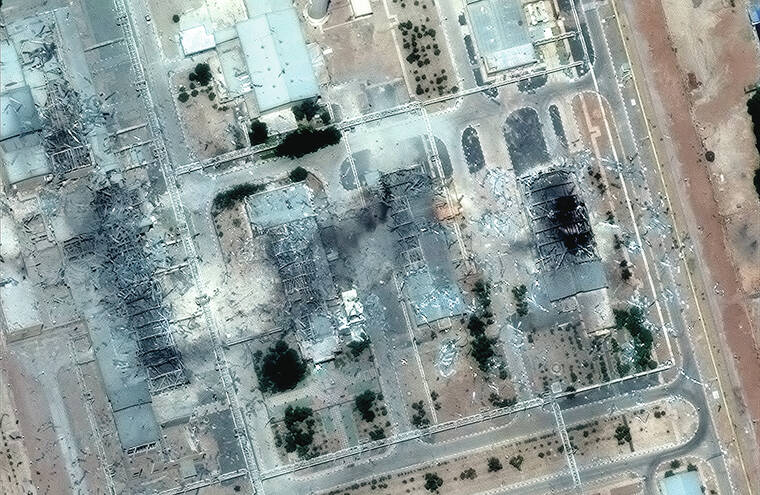
The United States on Sunday warned Iran not to retaliate after a series of surgical strikes by American B-2 bombers and missiles caused what U.S. officials described as “severe damage” to Iran’s nuclear operations.
Defense Secretary Pete Hegseth said at a news conference Sunday morning that any retaliation for the strikes “will be met with force far greater than what was witnessed” the previous night.
ADVERTISING
Hours after the strikes, Iran’s Revolutionary Guard threatened to retaliate, possibly by attacking the vast number of U.S. bases and forces in the Middle East, in a statement carried by the Iranian state news media. “Iran reserves all options to defend its sovereignty, interest, and people,” Abbas Araghchi, the Iranian foreign minister, said on social media after the strikes.
Iran’s appetite and capacity for a counterstrike are unknown. Especially now that its proxy forces, including Hamas in the Gaza Strip and Hezbollah in Lebanon, have been hobbled, its leaders do not want to show weakness. Yet Israeli airstrikes in the past week have destroyed at least half of Iran’s missile launchers and an unknown number of missiles.
The lack of Iranian air defenses was evident Saturday night, as American bombers flew a 37-hour round-trip mission from Whiteman Air Force Base in Missouri. The attack, which required a squadron of the world’s most advanced bombers, multiple midair refueling missions and more than a dozen massive “bunker-buster” bombs, met no resistance from Iranian fighter jets or surface-to-air missiles.
The damage did not prevent Iran from launching a barrage of missiles at Israel on Sunday. The missiles wrecked buildings but caused few fatalities, Israeli authorities said. Also on Sunday, Israeli air force jets carried out a “wide” operation against sites related to Iran’s ballistic missile apparatus, Brig. Gen. Effie Defrin, the Israeli military’s chief spokesperson, said in a televised statement. The attack included military facilities in Yazd, a central province in Iran, where seven members of Iran’s Revolutionary Guard and two conscript soldiers were killed, according to a statement published by the state-affiliated Tasnim News Agency.
Also unknown is the extent to which the Iranian nuclear operations were damaged by the American bombing. President Donald Trump immediately claimed success, adding that three nuclear facilities had been “completely and totally obliterated.” Other leaders in the Trump administration, and in U.S. and Israeli military intelligence, described the destruction in more measured terms.
In an interview on “Meet the Press” on Sunday, Vice President JD Vance said: “We destroyed the Iranian nuclear program.” Then he appeared to hedge, stating that the program had been “substantially delayed.” An initial analysis by the Israeli military found the heavily fortified nuclear site at Fordo has sustained serious damage, but was not completely destroyed, according to two Israeli officials with knowledge of the matter.
Even so, U.S. officials were counting on damage from the attack to compel Iran to agree to give up its nuclear enrichment program. Iran’s leaders have claimed the program was meant only for civilian purposes, but U.S. intelligence agencies agreed the country had enough highly enriched uranium that it could soon make nuclear bombs. Iran has said it will never give up its right to enrichment.
Secretary of State Marco Rubio, speaking Sunday on CBS’ “Face the Nation,” said that “it doesn’t matter if the order was given” by Iran’s leaders to develop a weapon, since the enrichment levels that Iran already had attained were far beyond anything needed for civilian use.
“America has been truly unsurpassed,” Prime Minister Benjamin Netanyahu of Israel said in a prerecorded statement. “It has done what no other country on Earth could do.” His comments acknowledged that Israel does not possess a bomb capable of destroying deep underground military installations like Iran’s enrichment site at Fordo, nor does it have aircraft capable of carrying such heavy bombs.
Saturday’s attack was momentous both militarily and politically. It was the first overt operation by the U.S. military on Iranian soil in decades, ordered by a president who campaigned on avoiding foreign entanglements. Trump has largely stood by that campaign promise, and when he did not, Iran retaliated with force.
During his first term, Trump authorized a drone strike that killed a powerful Iranian general in Baghdad. Iran retaliated with a barrage of missiles fired at U.S. troops in Iraq, leaving some 110 troops with traumatic brain injuries and unintentionally hitting a Ukrainian passenger jet, killing all 176 people aboard.
Political response to Saturday’s attack fell largely along partisan lines. Sen. Adam Schiff, D-Calif., said Trump’s “unilateral decision” to strike Iran without approval from Congress “was not constitutional.” Trump also faced criticism from some Republicans, including Rep. Thomas Massie of Kentucky, who introduced a bipartisan resolution last week that would have required the Trump administration to seek congressional approval before attacking Iran.
Iran posed “no imminent threat to the United States,” Massie said on CBS’ “Face the Nation” on Sunday, and he warned that Republican voters were “tired of endless wars in the Middle East.”
Other Republicans defended the action. Sen. Tom Cotton of Arkansas, chair of the Senate Intelligence Committee, noted that the goal is limited to stopping Iran’s nuclear program, which he said posed a threat to the United States and its allies.
“We’re not going to invade Iran,” he said on ABC’s “This Week” on Sunday. “We’re not going to try to topple their government or try to replace it with a new government.”
The attacks left all sides wondering what happens next. On Saturday, before the attacks, the Houthi militia of Yemen had threatened to break the truce they had reached with Trump in May and attack U.S. targets if Washington attacked Iran.
“In the event that the Americans become involved in the attack and aggression against Iran alongside the Israeli enemy, the armed forces will target their ships and warships in the Red Sea,” the Houthis’ military spokesperson, Yahya Saree, said Saturday.
After the attacks, Trump posted a threatening all-caps message on Truth Social on Saturday night: “ANY RETALIATION BY IRAN AGAINST THE UNITED STATES OF AMERICA WILL BE MET WITH FORCE FAR GREATER THAN WHAT WAS WITNESSED TONIGHT.”
The government of Bahrain, an island nation in the Persian Gulf and host to a U.S. naval base that could be the target of Iranian retaliation, warned residents to use main roads “only when necessary” Sunday.
Other countries in the Middle East responded with muted criticism of the attacks, stopping short of overtly condemning the United States. Qatar’s Foreign Ministry said it regretted “the deterioration of the situation with the strikes on Iranian nuclear facilities,” and expressed hope that all parties would “exercise wisdom” and restraint, in a statement that did not mention the United States at all. Kuwait and the United Arab Emirates also expressed concern about the bombings, but avoided mentioning the United States.
The bombing of the three nuclear sites deep inside Iran gave the world a stunning display of U.S. military might.
B-2 stealth bombers took off from Whiteman AFB just after midnight Saturday. One or more of the planes flew west over the Pacific, acting as a decoy to distract from the seven bombers flying east toward Iran. The heavy bombers refueled multiple times over the Atlantic Ocean, then linked up with American fighter planes as they entered Middle Eastern airspace at around 5 p.m. Eastern time.
At about the same time, a U.S. Navy submarine in the region launched more than a dozen Tomahawk cruise missiles at a nuclear site in Isfahan.
The B-2 bombers reached their targets, the nuclear sites at Fordo and Natanz, around 6:40 p.m. Approximately 75 precision-guided munitions were used, including 14 GBU-57 Massive Ordnance Penetrator bombs, which are designed to hit deeply buried targets. It was the first time such bombs had been used in combat.
The bombers left Iranian airspace at 7:30 p.m. Twenty minutes later, Trump announced the attack on social media.
Araghchi said Sunday that he would travel to Moscow and meet with President Vladimir Putin of Russia. The Russian Foreign Ministry issued a statement Sunday condemning the U.S. military intervention, which it said undermined global efforts to contain the proliferation of nuclear weapons.
But there were indications that the Kremlin may tread lightly, analysts said. Russian officials had not confirmed by Sunday whether any meeting between Araghchi and the Russian president would actually take place. Putin may wish to avoid antagonizing Trump for fear of drawing the American president closer to the Ukrainian side at a time when Russia is pressing its military advantage in peace talks to end its war in Ukraine.
This article originally appeared in The New York Times.
© 2025 The New York Times Company
Get the Latest News
Most Popular
