Mahmoud Khalil is released on bail after federal judge’s order
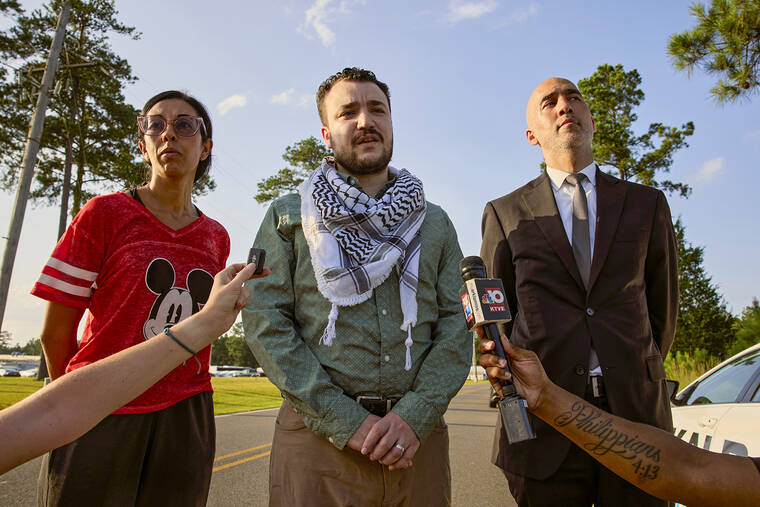
Mahmoud Khalil, the first pro-Palestinian campus protester detained by the Trump administration, was released on bail Friday after a judge ordered an end to his monthslong imprisonment.
Khalil, a Columbia University graduate and legal permanent U.S. resident, had been held for 104 days, watching as other students targeted by the administration won favorable rulings and were released on bail. He was denied the opportunity to be present when his wife gave birth to their son in April and he missed his graduation from Columbia.
ADVERTISING
But his lawyers slowly chipped away at the government’s case, and Friday they convinced the judge, Michael E. Farbiarz of U.S. District Court in Newark, New Jersey, that there was reason to believe that Khalil’s detention represented unlawful retaliation for his role in demonstrations on Columbia’s Manhattan campus.
Toward the end of a two-hour hearing, Farbiarz said there was “at least something” to the argument that there had been “an effort to use the immigration charge here to punish Mr. Khalil.”
“And, of course, that would be unconstitutional,” he added, before ordering the release.
Khalil walked out of the detention center in Jena, Louisiana, shortly before 7 p.m. local time Friday.
A spokesperson for the Homeland Security Department, Tricia McLaughlin, had suggested earlier in the day that Farbiarz would not have the last word.
“An immigration judge, not a district judge, has the authority to decide if Mr. Khalil should be released or detained,” she said in a statement.
McLaughlin cited a decision Friday by the Louisiana judge in Khalil’s immigration case, Jamee Comans. In the decision, Comans denied Khalil asylum and ruled that he could be deported based on another of the government’s allegations against him. She also denied him a bail hearing in her court.
“On the same day an immigration judge denied Khalil bond and ordered him removed, one rogue district judge ordered him released,” McLaughlin said. “This is yet another example of how out-of-control members of the judicial branch are undermining national security.”
Farbiarz’s decision marked an end to the initial stage of President Donald Trump’s campaign against pro-Palestinian student demonstrators, which began in early March with Immigration and Customs Enforcement agents bearing down on Northeast college campuses where the targets lived and studied.
Legally, the detention campaign has been unsuccessful, with other high-profile students, including Rumeysa Ozturk, Mohsen Mahdawi and Badar Khan Suri, already having been freed.
The politics of the effort, however, are more complicated, and the administration may have achieved a broader goal of suppressing pro-Palestinian speech. Farbiarz said as much when he noted that Khalil’s detention had chilled his First Amendment-protected activities.
In a statement, Dr. Noor Abdalla, Khalil’s wife, heralded the judge’s ruling.
“This ruling does not begin to address the injustices the Trump administration has brought upon our family and so many others,” she said, adding: “But today we are celebrating Mahmoud coming back to New York to be reunited with our little family, and the community that has supported us since the day he was unjustly taken for speaking out for Palestinian freedom.”
Khalil was the most prominent of Trump’s student targets. His sudden arrest in March was followed by a burst of fanfare from the White House. The president called him a “radical foreign pro-Hamas student” and pledged that other arrests would follow. His press secretary, Karoline Leavitt, said Khalil was “siding with terrorists,” and she accused him of having been involved in handing out pro-Hamas flyers.
And Secretary of State Marco Rubio invoked a rarely cited law, saying that Khalil should be deported because his mere presence in the United States threatened the administration’s foreign policy goal of preventing antisemitism.
Khalil’s lawyers have disputed the claim that he has spread antisemitism. They have cited his past comments, including a statement he made on CNN that “the liberation of the Palestinian people and the Jewish people are intertwined and go hand by hand, and you cannot achieve one without the other.”
More than a week after Khalil was arrested, the government added a second allegation against him, accusing him of misrepresenting his employment history on his 2024 application for permanent residency.
The government said Khalil had failed to disclose his membership in several organizations, including a United Nations agency that helps Palestinian refugees, and did not mention work he had done for the British government after 2022.
Khalil’s lawyers have called the allegations bogus. They have said that his employment with the British government did end after 2022 and that his work for the U.N. agency was part of his Columbia coursework.
Farbiarz, who has overseen the case since March, moved methodically through the cascade of legal issues, writing dozens of pages on jurisdictional issues alone. But over time, he began to cut off some elements of the government’s argument for continuing to hold Khalil. Last week, he ruled that the foreign policy statute invoked by Rubio could not be used to justify Khalil’s detention.
The Trump administration then explained that it would continue to hold Khalil for the allegations related to his residency application, despite an indication by Farbiarz that he would look askance at that rationale.
On Friday, Farbiarz rebuked the government mildly, noting that it had offered no evidence to suggest that Khalil was a danger to his community. The administration’s claims about his links to, or even sympathies for, Hamas have not been substantiated in court.
“He is not a danger to the community, period, full stop,” the judge said.
He also said that the government’s behavior in Khalil’s case — in effect, continuing to detain him on the job history allegations — was “highly, highly, highly unusual.”
While other judges have been quicker to free student protesters, expressing strong skepticism of the Trump administration’s motives, Farbiarz’s handling of the case presumed the government’s good faith. That has been a typical practice in federal courts but one that has been challenged in the Trump era, with some judges accusing the government of playing fast and loose with the truth.
On Friday, Fabiarz systematically dismantled the arguments of the government’s lawyer, Drhuman Sampat, moving from procedural issues to the fundamental question that would determine his decision to release Khalil.
The judge appeared more open to arguments made by one of Khalil’s lawyers, Alina Das, who said the government’s determination to keep Khalil confined only strengthened her case.
“They’ve been targeting Mr. Khalil from the start based on his speech and his viewpoint,” Das said.
The administration can appeal Farbiarz’s ruling, and even if it is unsuccessful, will almost certainly continue trying to deport Khalil.
But the immigration case will proceed with him free and back in New York with his family.
This article originally appeared in The New York Times.
© 2025 The New York Times Company