Canceled humanities grants to help pay for trump’s ‘Garden of Heroes’
The National Endowment for the Humanities intends to redirect some of its funding to build President Donald Trump’s proposed National Garden of American Heroes as part of a reorientation toward the president’s priorities of celebrating patriotic history, according to three people who attended a meeting Wednesday where the plans were discussed.
Last week, the agency, the main federal funder of the humanities, abruptly canceled more than 85% of its existing grants, which support museums, historical sites and scholarly and community projects across the country. The moves outraged supporters of the humanities and stirred speculation about whether the agency would survive.
ADVERTISING
At the meeting Wednesday, the agency’s acting chair, Michael McDonald, told its 24-member advisory council that the endowment would pivot to supporting the White House’s agenda, according to the three attendees, who were granted anonymity because they were not authorized to describe a confidential meeting. In particular, they were told, the agency would support Trump’s planned patriotic sculpture garden and the broader celebration of the 250th anniversary of American independence on July 4, 2026.
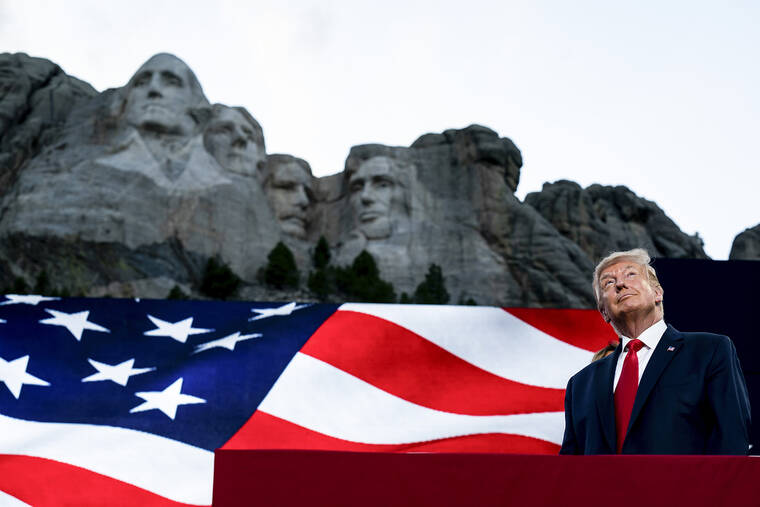
Trump first proposed the sculpture garden in July 2020, shortly after delivering a fiery political speech at Mount Rushmore in which he decried the vandalism of statues across the country during racial justice protests set off by the murder of George Floyd.
“Our nation is witnessing a merciless campaign to wipe out our history, defame our heroes, erase our values and indoctrinate our children,” Trump said.
In an executive order, he directed the construction of a National Garden of American Heroes, to be built “on a site of natural beauty that enables visitors to enjoy nature, walk among the statues, and be inspired to learn about great figures of America’s history.” All would be depicted in a “realistic” fashion, with no abstract or modernist sculpture.
In a second order in January 2021, two days before leaving office, Trump provided a long list of potential honorees from all fields and backgrounds. It included traditional heroes like George Washington, Abraham Lincoln, Frederick Douglass, Sacagawea, Neil Armstrong, Babe Ruth, Martin Luther King Jr., John F. Kennedy and the Wright brothers. But there was also an eclectic mix of figures from the arts, culture and sports, including Walt Whitman, Kobe Bryant, Johnny Cash, Julia Child, Elia Kazan and Hannah Arendt, as well as a number of conservative intellectuals and activists, including Whittaker Chambers and Russell Kirk.
That second order also directed that one-twelfth of the budgets of the humanities endowment and the National Endowment for the Arts be directed to the project. Each endowment had a budget of $207 million last year.
Both of Trump’s orders were rescinded by President Joe Biden. But shortly after returning to office, Trump reinstated them in a new order titled “Celebrating America’s 250th Birthday.” At the same time, he has moved to reshape or seize control of federal cultural institutions, from the Kennedy Center to the Smithsonian Institution.
No details about the garden or its potential location have been released. But last month, Larry Rhoden, the governor of South Dakota, sent a letter to Trump suggesting that it be built in the Black Hills, near Mount Rushmore.
The White House and McDonald, the agency chair, did not immediately respond to requests for comment.
At this week’s meeting, attendees said, McDonald said that about $17 million from the National Endowment for the Humanities and about $17 million from the National Endowment for the Arts would be directed to the Garden of Heroes. The hypothetical cost of each statue, described as somewhere between $100,000 and $200,000, was also discussed, attendees said.
© 2025 The New York Times Company