Parity, bigger field mean there could be surprises at the Women’s World Cup
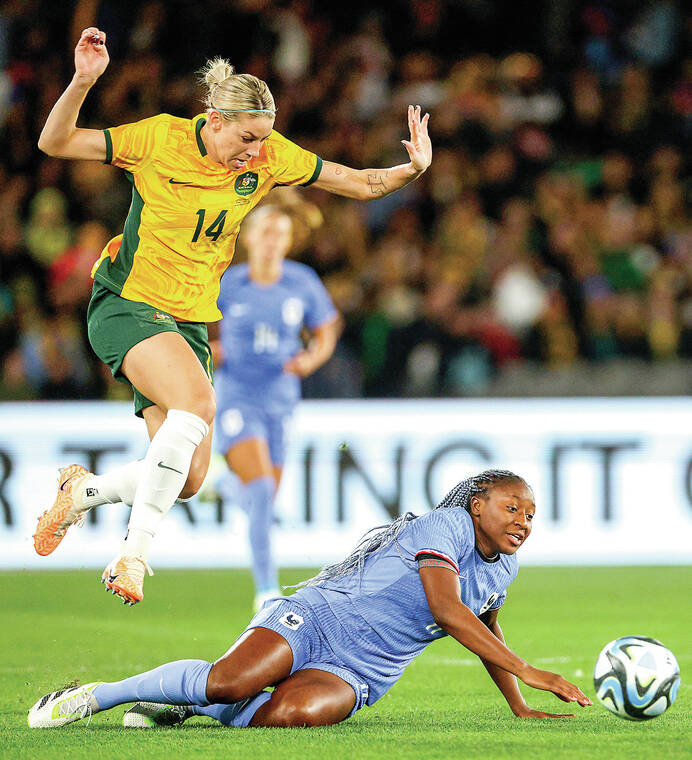
There could be some surprises at the Women’s World Cup.
Sure, the U.S. is still considered dominant, and those elite European teams have developed even more with the rise of competitive clubs. Then there’s Brazil, which always seems on the verge of a breakout.
ADVERTISING
But an expanded field of 32 teams at the tournament starting Thursday in Australia and New Zealand means more players will see the international spotlight — and they no doubt want to prove they belong.
Consider Japan.
Back in 2011, Japan wasn’t expected to make the semifinals, let alone the championship match. But the Japanese, reeling from the earthquake and tsunami that devastated their country earlier that year, rallied and beat the Americans on penalties after a 2-2 draw, and in the process became the first Asian team to win soccer’s top prize.
That was the last Women’s World Cup that wasn’t won by the United States. The No. 1-ranked Americans aim to make it three in a row.
U.S. coach Vlatko Andonovski is well aware that other countries are catching up. He pointed to Zambia’s exhibition victory over Germany in the run-up to the tournament.
“The top 10 have always been there. The world that is catching up is Wales, is Vietnam, is Zambia, Portugal. These are these are the countries that are catching up. The 7-0, 8-0 games are gone. And we can see that Germany plays against Zambia, loses 3-2. Those games are going to happen,” Andonovski said. “And that’s what we are preparing ourselves for, so we don’t run into a game like that with the mentality that it’s gonna be easy. No game is gonna be easy. It doesn’t matter who’s in front of us.”
Canada is considered among those top teams, particularly after winning the Olympic gold medal at Tokyo. But coach Bev Priestman suggested that growing parity means there are no givens.
“It could really throw up some surprises just on tournament football, you can lose group-stage games and then go on to win the thing. So yeah, it’s tighter than it’s ever been,” Priestman said.
There are eight teams debuting at the tournament, including Ireland, Vietnam, Zambia, Haiti, Morocco, Panama, Portugal and Philippines. While most stand little chance against the likes of France or Sweden, there’s always that hope. And there’s hope that the international stage will help push federations to invest in more for the teams that don’t traditionally have support.
“A lot of federations are slowly getting into the trend of being better,” South Africa forward Thembi Kgatlana said.
More than a game
Players are well aware that the World Cup gives them the platform to speak about inequity, human rights and a whole host of social issues.
At the World Cup final four years ago in France, fans chanted “Equal Pay!” in support of the Americans’ fight for equitable compensation to their male national team counterparts. The players struck a contract that equalized pay last year.
Now other teams are joining the call for better pay and conditions. A group of international players, backed by the global players association FIFPRO, called on FIFA to increase prize money and make sure that each player at the tournament gets a share of those funds.
As a result, all 736 players participating at this World Cup will each get at least $30,000, an amount that increases the further teams advances in the tournament. FIFPRO has vowed to make the money gets to the players.
The overall fund for this World Cup is $152 million, covering prize money, team preparation and payments to players’ clubs. That’s a 300% increase over the funds for the 24-team edition in 2019, and 10 times what it was in 2015.
It’s just a number
It’s hard to say who has had more of an impact on women’s soccer in their home countries: Canada’s Christine Sinclair or Brazil’s Marta. Both players will be making their sixth appearance at the World Cup.
Sinclair, 40, holds the international scoring record, among both men and women, with 190 career goals. She’s played in 323 games for Canada.
Marta, 37, a six-time FIFA World Player of the Year, has scored 115 goals for Brazil in 174 appearances. Marta is the tournament’s all-time leading scorer with 17 goals and will vie to be the first player to score in six World Cups.
They are not the only players to make a sixth World Cup roster: Nigeria’s Onome Ebi, 40, is about a month older than Sinclair and is the oldest in the tournament.