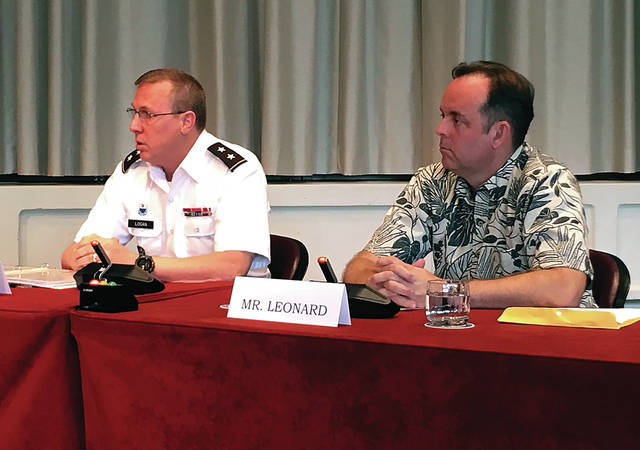
HONOLULU — The Hawaii Emergency Management Agency began implementing its plan for responding to a ballistic missile attack before it was entirely drafted, a senior state official said Thursday at a hearing on why the agency mistakenly sent cellphone and broadcast alerts across the islands in January.
“We started flying the plane before we built the whole plan,” Maj. Gen. Arthur “Joe” Logan, head of the state Department of Defense, told a U.S. Senate committee hearing in Honolulu.
Logan told lawmakers he felt it was imperative to implement the plan, given North Korea’s repeated ballistic missile and nuclear tests and its threats toward Hawaii.
The plan also involved helping the state survive a possible attack.
U.S. Sen. Brian Schatz of Hawaii held the hearing to understand how and why the false alerts were sent.
Logan said the agency was expecting to develop its plan in three phases.
The first involved conducting public outreach and speeding up public notifications in the event of an attack.
During the second phase, the agency intended to talk to stakeholders about how best to respond to and recover from an attack. The third phase was to write the plan.
Logan said January’s false alert went out because the agency lacked certain protocols to prevent such mistakes and immediately correct them.
Schatz, a Democrat and ranking member of the Senate Subcommittee on Communications, Technology, Innovation and the Internet, has introduced legislation that would give the federal government sole responsibility for handling missile alerts.
In January, the full committee examined policy concerns surrounding the use and effectiveness of the current warning system after the false alert was sent to Hawaii residents and visitors statewide. Schatz also requested the field hearing.
Schatz and other Hawaii lawmakers at the hearing acknowledged that emergency alerts for hurricanes and other natural disasters are issued by local and state governments.